Egypt
The gift of the Nile: one of the oldest civilisations in history, on a ribbon of fertile land running through the desert for five thousand years.
only ~5% inhabited
everyday Egyptian Arabic
At a glance
Egypt is, as the Greek historian Herodotus already wrote, "a gift of the Nile". The country is almost entirely desert, but a mighty river crosses it from south to north, and it is on its banks, a ribbon of green land just a few kilometres wide, that almost all of the more than 100 million Egyptians live. Between Africa and Asia, and in control of the Suez Canal, the country has always linked several worlds. Its capital, Cairo, is the largest city in the Arab world.
Geography
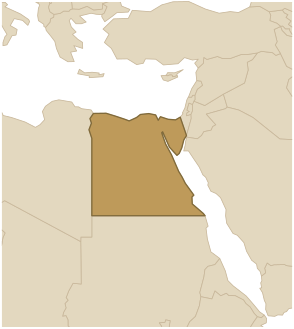
In Egypt, everything is a matter of river and sand. The Nile, one of the two longest rivers in the world, flows in from the heart of Africa, runs through a long, narrow valley, then fans out in the north into a vast delta before reaching the Mediterranean. On either side lie absolute deserts: to the west, the sand desert of the Sahara; to the east, a mountainous desert along the Red Sea and its reefs. To the north-east, beyond the Suez Canal, the Sinai Peninsula links Africa to Asia.
History
Egypt has one of the longest histories of humankind. The civilisation of the pharaohs arose more than five thousand years ago and lasted nearly three millennia: the pyramids of Giza, already more than two thousand years old in Cleopatra's time, the temples of Luxor and the Valley of the Kings remain from it. Then came Alexander's Greeks, who founded Alexandria, and then Rome, for which Egypt was the breadbasket. In 641 the Arab conquest brought Islam and the Arabic language; the Fatimids founded Cairo in 969. Then came the Mamluks, the Ottomans, Bonaparte's brief expedition and the British, until the Republic was proclaimed in 1953.
Language and religion
Egyptians speak Arabic, above all everyday Egyptian Arabic, probably the most widely understood dialect in the Arab world thanks to the films and songs of Cairo. The language of the pharaohs has survived to this day in the Coptic liturgy. The country is overwhelmingly Sunni Muslim, and Cairo's al-Azhar university is one of the most respected in Islam; it is also home to the Copts, one of the oldest Christian communities in the world, direct heirs of pre-Islamic Egypt.
Culture and way of life
In the 20th century Cairo was the cultural capital of the Arab world, with its "Hollywood" and its great music scene; the voice of Umm Kulthum, idolised across the Arab world, remains its symbol. People meet over tea in Cairo's old cafés, eat koshari, a popular dish of rice, pasta and lentils, and have ful, stewed fava beans, for breakfast. Everywhere, monuments recall five thousand years of history.