Eritrea
A country of high plateaus and Red Sea coastline in the Horn of Africa, marked by a long war of independence and an old crossroads between Africa and Arabia.
At a glance
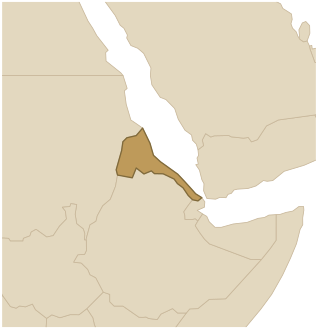
Eritrea is a country in the Horn of Africa, with the Red Sea along its entire length, facing Arabia, between Sudan, Ethiopia and Djibouti. It is made up of cool highlands and scorching coasts. Nearly four million people live there, from nine ethnic groups, around the capital, Asmara, which sits high on the plateau and is known for its Italian Art Deco architecture. Eritrea has only been independent since 1993, after one of the longest liberation wars in Africa. Today it is one of the most closed countries in the world.
Geography
Eritrea has two faces. Inland are cool, fertile highland plateaus, an extension of the Ethiopian mountains, where most people live and farm, around Asmara. Toward the sea, the land drops sharply to the coastal plain and the Danakil Depression, one of the hottest and lowest places on earth, a land of salt, volcanoes and lava. The long Red Sea coast and the Dahlak archipelago have very rich waters and reefs.
History
In ancient times this land was part of the great kingdom of Aksum, whose port of Adulis, on the Red Sea, was a gateway for trade between Africa, Rome and India. Long tied to Ethiopia, Eritrea became an Italian colony in the late 19th century, which gave it a separate identity. After the Second World War it was joined to Ethiopia against the will of many Eritreans, setting off a thirty-year war of independence, one of the longest in Africa. Independence, won in 1993, was followed by a very authoritarian and closed regime that has driven many Eritreans into exile.
Languages and faith
Eritrea has several languages: Tigrinya, the Semitic language of the highlands, and Arabic dominate, along with Tigre and the languages of the other peoples. Tigrinya is written in the Ge'ez script, shared with Ethiopia. The population is split almost evenly between Orthodox Christianity, one of the oldest churches in the world, inherited from Aksum, in the highlands, and Sunni Islam, just as old, on the coast and in the lowlands. The two generally live together peacefully.
Culture and way of life
Eritrean culture mixes the heritage of the highlands, the Red Sea and a touch of Italy. There is the coffee ceremony, long and sociable, where the beans are roasted and served amid incense. There is injera, a large, soft, sour flatbread eaten by hand with spicy stews (tsebhi), found across the region. There is Art Deco Asmara, with its 1930s cafés and cinemas, a World Heritage Site. And there are the embroidered white cloths, and the music and dances of each people.