Western Sahara
A vast desert territory on the Atlantic coast of the Sahara, home of the Sahrawi people, whose status is disputed and still unsettled.
+ refugees in camps
+ Spanish, Berber
At a glance
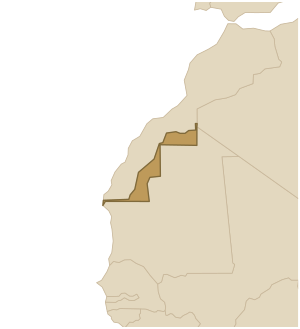
Western Sahara is a vast desert territory on the Atlantic coast of north-west Africa, between Morocco, Mauritania and Algeria. Its status is one of the most disputed in the world: a former Spanish colony, it is now largely administered by Morocco, which claims it, while the Polisario Front independence movement proclaims a Sahrawi republic there, recognised by some states. The United Nations lists it as a "non-self-governing" territory and has not yet reached a settlement. The Sahrawi people, Arab-Berber and nomadic in origin, live partly in the territory and partly in large refugee camps in Algeria.
Geography
Desert covers almost all of Western Sahara: vast hamadas (stony plateaus), gravel plains and dunes under a relentless sky, in one of the driest and least populated regions on earth. Yet this desert runs along a long Atlantic coast, with cold water rising from the deep and very rich in fish, one of the territory's great resources. A few oases, dry riverbeds and rare wells dot the emptiness, and the ground holds large phosphate deposits. The climate is scorching and dry inland, softened on the coast by sea mist and the trade winds.
History
This land was home to Sanhaja Berber tribes, nomadic camel herders, and then, from the 13th century, to the Arab Beni Hassan tribes, whose language and culture took over: the Sahrawi people grew out of this mix. Long crossed by trans-Saharan caravans, the region was colonised by Spain in the late 19th century. When Spain withdrew in 1975, Morocco and Mauritania moved in while the Polisario Front declared independence, starting a long war. A UN-brokered ceasefire was agreed in 1991, pending a self-determination referendum that was never held; it broke down in 2020. The territory's status remains unresolved.
Language and faith
Sahrawis speak Hassaniya Arabic, an Arabic dialect of the Bedouin tribes of Western Sahara and Mauritania, with Berber words; many also speak Spanish, a colonial legacy, which is rare in the Arab world. They are Sunni Muslims, often with a strong Sufi and marabout tradition, and Islam shapes social life, the calendar and customs. Faith, the tribe and attachment to the desert are central to Sahrawi identity.
Culture and way of life
Sahrawi culture is that of the Bedouin desert nomads, Arab-Berber, shaped by the camel and the tent. Life centres on the khaima, the large traditional tent, around which hospitality is organised; tea is served in three glasses following an unchanging ritual; poems are sung and improvised in Hassaniya; women wear the melhfa, a long colourful veil, and music is played on drums and lute. The camel and herding remain central to how people see themselves. People eat mechoui (roast lamb), rice, fish on the coast and dates, and drink camel milk and mint tea.