Spain
The tip of Europe closest to Africa, an old crossroads of peoples and, in the 16th century, the centre of a global empire.
+ Catalan, Galician, Basque
At a glance
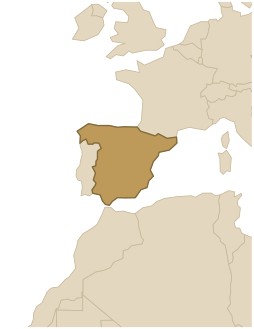
Spain covers most of the Iberian Peninsula, in the far south-west of Europe, separated from Morocco by a strait only fourteen kilometres wide. About 48 million people live there, around the capital, Madrid, in the middle of the country. Five centuries ago it was the world's leading power, at the head of an empire "on which the sun never set".
Geography
The country is built around a vast central plateau, the Meseta, ringed by mountains: the Pyrenees close it off to the north-east, and the snowy Sierra Nevada rises in the south. The north is green and rainy, facing the Atlantic; the centre is dry and continental; the east and south are Mediterranean, covered in olive groves and vineyards. Three great rivers (the Ebro, the Tagus and the Guadalquivir) run down to two seas.
Peoples and history
Iberians and Celts, then Phoenicians and Greeks along the coasts: Spain is a very old crossroads. Rome held it for six centuries and left it the Latin language. The decisive event was the arrival of Islam in 711: for centuries, al-Andalus was one of the high points of the medieval world, with Córdoba, its science and its poets, and the Alhambra of Granada, where Christians, Muslims and Jews lived side by side for a long time. The Christian Reconquista ended in 1492, the very year Columbus sailed west: Spain was entering its Golden Age. After the civil war and Franco's dictatorship, the country returned to democracy in the late 1970s.
Language and religion
Castilian, which we call Spanish, grew out of Latin but keeps nearly four thousand words from the Arabic of al-Andalus. Other languages are official in their regions: Catalan, Galician and Basque. The country is Catholic by tradition (the Santiago de Compostela pilgrimage, the Holy Week processions), and it remembers the three religions that made its Middle Ages so rich.
Culture
Spain means flamenco, born in Andalusia, and the guitar; a literature that gave the world Cervantes's Don Quixote; the painters Velázquez, Goya, Picasso and Dalí, and the architect Gaudí. At the table there is cured ham, paella, tapas for sharing, and olive oil, of which the country is the world's largest producer.