Estonia
The northernmost of the Baltic countries, a land of forests, islands and bogs, whose people, cousins of the Finns, have become digital pioneers.
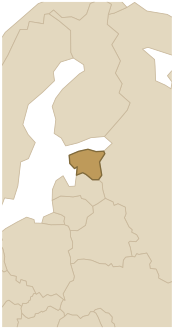
At a glance
Estonia is the northernmost of the three Baltic countries, facing Finland across the Gulf of Finland. It is a small country of just over 1.3 million people, around the capital, Tallinn, whose medieval old town, with its walls and spires intact, is one of the best preserved in Europe. Unlike their neighbours, Estonians are neither Slavic nor Baltic: they are Finno-Ugric, cousins of the Finns. Since independence the country has become a world pioneer in all things digital.
Geography
Estonia is a flat country, half covered in forest and dotted with thousands of lakes, rivers and vast bogs, ancient wetlands crossed on wooden boardwalks. Its deeply indented coast has more than two thousand islands, including the large island of Saaremaa, with its windmills and junipers. Bears, wolves and lynx still live in the forests. Summers are bright, winters long and snowy.
History
Settled since very early times by Finno-Ugric tribes, Estonia was one of the last pagan regions of Europe before it was conquered and forcibly converted to Christianity in the 13th century by the Danes and the Teutonic Knights; Tallinn became a rich city of the Hanseatic League. Ruled in turn by Germans, Swedes and Russians, Estonia won its first independence in 1918, before being crushed between the USSR and Nazi Germany. Re-annexed by the Soviets, it regained its freedom in 1991 at the end of the "Singing Revolution", a peaceful movement carried by huge mass gatherings of song.
Language and faith
Estonian is not an Indo-European language: like Finnish, it belongs to the Finno-Ugric family and is unrelated to neighbouring Latvian or Russian; it is rich in vowels and known for being difficult. Estonia is one of the most secular countries in the world: Lutheran by tradition, a legacy of German and Swedish rule, it now has very few churchgoers. Attachment to the old pagan heritage, to nature and the forests, remains strong in folklore and festivals.
Culture and way of life
Like its Baltic neighbours, Estonia is a land of song: its great Song Festival brings together tens of thousands of choir singers, and it was by singing that the country won back its freedom. Its national epic, the Kalevipoeg, tells of a world of giants and spirits. The country has become a digital champion: online government, electronic voting, digital identity; Skype was developed here. People love nature, the sauna and the forest, and northern food of black bread, fish and wild produce.