Ethiopia
The old highland kingdom of the Horn of Africa, one of only two countries on the continent never colonised, with its own script, its own calendar and one of the oldest churches in the world.
+ Oromo, Tigrinya… (~80 languages)
with Liberia, the only case in Africa
At a glance
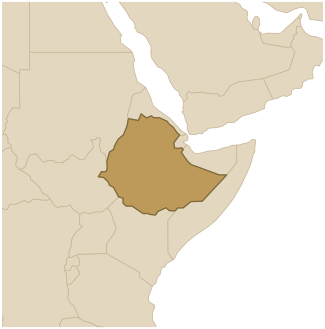
Ethiopia lies at the heart of the Horn of Africa. It is a country of high plateaus, a vast mountain fortress above the surrounding deserts, which gives it a temperate climate despite its tropical latitude and long protected it. With about 130 million people, it is one of the most populous countries in Africa and one of the oldest states in the world: its unity, its faith and its script go back to ancient times. Its capital, Addis Ababa, seat of the African Union, is one of the highest in the world.
Geography
The great Rift Valley, a huge crack in the earth's crust where the continent is slowly tearing apart, cuts the country in two, with its lakes and volcanoes. On either side rise the highlands, green and cool, cut by deep canyons and topped by peaks of more than four thousand metres. It is in these highlands that the Blue Nile rises, bringing Egypt most of its water. To the east, the land drops into one of the hottest depressions on the planet, the Danakil.
History
Ethiopia traces its history back three thousand years, to the Queen of Sheba and King Solomon. In ancient times the powerful kingdom of Aksum arose, one of the great empires of its day, which raised stone obelisks and, around 340, became one of the very first states to adopt Christianity. In the Middle Ages, kings had the churches of Lalibela carved out of solid rock. In the colonial era, as Europe was dividing up Africa, Ethiopia defeated the Italian army at Adwa in 1896; despite an Italian occupation from 1936 to 1941, it was never colonised. Its last emperor, Haile Selassie, was overthrown in 1974; since then the country has seen a Marxist regime, famines and wars, including the Tigray war (2020–2022).
Languages and faith
Ethiopia has its own script, Ge'ez, with its distinctive rounded letters, one of the few writing systems born in Africa. People speak Amharic, the state's working language, Oromo, Tigrinya and some eighty other languages. The country is one of the oldest Christian lands: the Ethiopian Orthodox Church, with its fasts, priests and frescoes, is one of the oldest churches in the world and keeps its own calendar, seven to eight years behind the Gregorian one. A very large Muslim population has lived alongside it since the earliest days of Islam, and the country was long home to a very old Jewish community.
Culture and way of life
Ethiopia gave the world coffee: according to tradition, the plant was discovered in the Kaffa region, and making it here is still a long ceremony in which the beans are roasted and shared with neighbours. At the table, people eat not from plates but from a large, soft flatbread, injera, made from a local grain, teff, which they tear off to scoop up spicy stews. Music with its own distinctive scales, shoulder dances and great religious festivals such as Timkat mark the year.