Falkland Islands
An archipelago in the South Atlantic off Patagonia, a British territory claimed by Argentina, a land of wind, sheep and penguins.
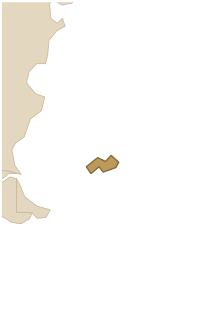
two large islands and many small ones
claimed by Argentina
At a glance
The Falkland Islands (Malvinas in Spanish) are an archipelago in the South Atlantic, off Patagonia, at the southern tip of South America. A British overseas territory, the islands are also claimed by Argentina, an old dispute that led to a short, deadly war in 1982. About 3,600 people live there, most of British descent, around the capital, Stanley, and they have voted almost unanimously to remain British. It is a land of wind, peat and sheep, known for its colonies of penguins and seabirds.
Geography
The Falklands are made up of two large islands, West Falkland and East Falkland, and hundreds of smaller ones, in the cold waters of the South Atlantic. The landscape, bare and swept by constant winds, is one of low hills, peat moorland, grassland and a deeply indented, treeless coast. The marine wildlife is very rich: five species of penguin breed there, along with albatrosses, sea lions and elephant seals, and orcas pass offshore. The climate is cool and oceanic, windy all year, and the weather changes constantly.
History
The islands were uninhabited when Europeans first reached them. The first settlements, in the 18th century, were French and English, followed by Spanish ones; sailors from Saint-Malo gave the islands their French name, "Malouines". After independence, Argentina took up the Spanish claim, but the British settled for good in 1833 and brought in colonists from the British Isles, who raised sheep. The long-running dispute with Argentina came to a head in 1982: an Argentine invasion set off a ten-week war, won by the United Kingdom. In 2013 the islanders voted almost unanimously to stay British; Argentina maintains its claim.
Language and faith
Falkland Islanders speak English, with an accent of their own. The islands are Christian by tradition, like the rest of the British world: Anglicanism dominates, and Stanley's small cathedral is the southernmost Anglican cathedral in the world; there are also Catholics and other churches. Religion plays a quiet part in the life of this small community, drawn close by isolation.
Culture and way of life
Falklands culture is British, adapted to rural life at the far end of the world. It is a culture of sheep and of the "camp" (the countryside), with its large, isolated farms and its horses. Horse races and agricultural shows bring people together, and afternoon tea is still a tradition. Wildlife watching (penguins, albatrosses) draws visitors. People eat lamb, fish and seafood, and jam made from diddle-dee, a local berry.