France
An old country of Western Europe, between the Mediterranean and the Atlantic, whose language, ideas and food have spread around the world.
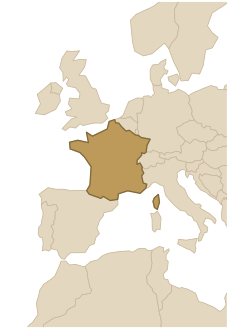
Metropolitan France
+ regional languages: Breton, Occitan, Alsatian…
At a glance
France covers a large part of Western Europe, with the Mediterranean to the south and the Atlantic and the Channel to the west and north. It is often said to be shaped like a hexagon, its borders, half by land and half by sea, tracing a fairly regular figure. About 68 million people live there, around the capital, Paris, one of the most visited cities in the world. The land has been settled for a very long time, and its villages, church towers and farming regions are very old.
Geography
The country has almost every landscape found in Europe. Great fertile plains cover the north and west, drained by long, slow rivers: the Seine, the Loire, the Garonne. To the east and south rise mountains: the Alps, with Mont Blanc, the highest peak in Western Europe, and the Pyrenees along the Spanish border. Between them lies the old, worn-down Massif Central, a land of extinct volcanoes. The climate is just as varied: mild and damp on the Atlantic, harsher and continental in the east, hot and dry around the Mediterranean, with its olive trees and vineyards.
Peoples and history
Before France there was Gaul, a group of Celtic peoples, the Gauls, whom Rome conquered in the 1st century BCE and thoroughly Romanised; this is where French comes from. When Rome fell, Germanic peoples settled, among them the Franks of Clovis, who gave the country its name. Then came a long Middle Ages of cathedrals, knights and kings, whose kingdom was built up gradually around Paris. In 1789 the Revolution overthrew the monarchy and proclaimed the rights of man, an idea that would travel around the world. Then came Napoleon, two world wars and finally today's Republic.
Language
French grew out of the Latin spoken in Gaul, slowly changing over the centuries. For a long time the country was a patchwork of languages (Celtic Breton in the west, the Occitan of the troubadours in the south, Germanic Alsatian in the east, Basque at the foot of the Pyrenees) before the French of Paris took over everywhere, largely through schooling. Once the language of diplomacy and the Enlightenment, it is now spoken on five continents.
Religion
For more than a thousand years France was a deeply Catholic country, the "eldest daughter of the Church": its Gothic cathedrals (Notre-Dame, Chartres, Reims) are among the most beautiful in the world, and pilgrims crowded the roads to Santiago. Torn apart in the 16th century by wars between Catholics and Protestants, it eventually adopted a principle of its own, laïcité, the strict separation of state and religion, written into law in 1905. Today it is one of the most secular countries in Europe, with large Christian, Muslim and Jewish communities.
Culture and way of life
France made its name through its way of life. The French gastronomic meal, on UNESCO's intangible heritage list, is a ritual: bread, hundreds of cheeses, wine from every region, long meals shared at the table. It is also the land of the novels of Hugo and Proust, of Impressionist painting (Monet, Renoir), of haute couture and of cinema, born here with the Lumière brothers.