Micronesia
A federation of islands in the western Pacific, home of the stone city of Nan Madol and the giant stone money of Yap.
+ Chuukese, Pohnpeian, Yapese…
At a glance
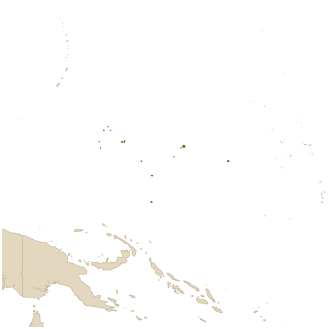
The Federated States of Micronesia are a federation of islands in the western Pacific, scattered from west to east across thousands of kilometres of ocean. The country brings together four very different island states, Yap, Chuuk, Pohnpei and Kosrae, hence its name. About 110,000 people live there; the capital, Palikir, is on Pohnpei. The country has a great diversity of cultures and languages, and some unique places: the megalithic city of Nan Madol, the stone money of Yap, and some of the richest lagoons in the world. It is tied to the United States by a free association agreement.
Geography
Micronesia has two kinds of island. There are high volcanic islands, mountainous and covered in rainforest, with waterfalls and rivers, such as Pohnpei and Kosrae, among the rainiest places on earth. And there are low coral atolls ringed by turquoise lagoons. The huge lagoon of Chuuk (Truk) is one of the most famous dive sites in the world: dozens of wrecks from the Japanese fleet sunk in the Second World War lie on the bottom, now covered in coral. The climate is equatorial, hot and humid, and some islands are exposed to typhoons.
History
Settled thousands of years ago by Austronesian navigators, these islands produced highly organised societies, as the city of Nan Madol, on Pohnpei, shows: a "Venice of the Pacific" made of about a hundred artificial islets and buildings of huge basalt blocks, capital of the Saudeleur dynasty and now a World Heritage Site. The islands later came under Spanish, German and then Japanese rule, before becoming a US-administered trust territory after the war. Micronesia became independent in 1986, in "free association" with the United States, which handles its defence and provides financial support.
Languages and faith
Micronesia has a great variety of languages: each island has its own Austronesian language (Chuukese, Pohnpeian, Yapese, Kosraean and others), and English, the official language, is the common language between the states. The country is overwhelmingly Christian, Catholic and Protestant, since the missionaries came, and faith is very present. It sits alongside deep respect for tradition, clans and chiefs, who keep real authority, especially on Yap, one of the most custom-bound islands in the whole Pacific.
Culture and way of life
Micronesian culture is rich and traditional, and changes from one island to the next. Its best-known curiosity is the stone money of Yap, the rai: huge limestone discs, some several metres across, used as money and as a sign of wealth; ownership can change hands without the stone ever being moved. There are also community houses, dances, songs, weaving and traditional navigation. People live from the sea and from fishing, taro, yams, breadfruit and coconut, and share sakau (kava) in the evening.