Gabon
A country of equatorial forest on the Atlantic, crossed by the equator, home of gorillas and national parks.
+ Fang, Myene…
At a glance
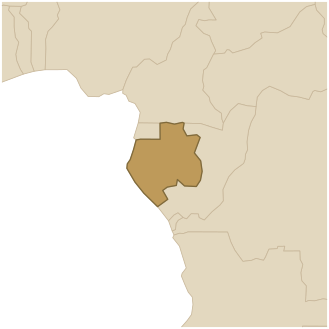
Gabon is a country in Central Africa, on the Atlantic coast, crossed by the equator. It is one of the most heavily forested countries on the planet: equatorial forest covers nearly nine-tenths of it and shelters very rich wildlife. Thinly populated, with about two and a half million people, mostly around the capital, Libreville, and fairly prosperous thanks to its oil, Gabon has chosen to protect its nature by setting aside a large part of its territory as national parks.
Geography
Gabon is covered in dense, humid equatorial forest, still largely intact, crossed by the great Ogooué River and its tributaries. It is home to some of the richest wildlife in Africa: lowland gorillas, chimpanzees, forest elephants, mandrills. In Loango National Park, elephants and hippos can be seen on the Atlantic beaches. The coast alternates between lagoons, estuaries and mangroves. The country's thirteen national parks cover more than a tenth of its territory and make it a model for conservation in Africa.
History
Settled through the Bantu migrations, including that of the Fang, who came later from the north, the Gabonese coast received Europeans from the 15th century onward and then suffered from the slave trade. In 1849, slaves freed from a slave ship were settled there and founded a town they named Libreville, "free town", like Freetown in Sierra Leone. A French colony within French Equatorial Africa, Gabon became independent in 1960. Its modern history was dominated by the Bongo family, in power from 1967 until a military coup in 2023.
Languages and faith
The official language is French, the common language in a country with some forty Bantu languages, including Fang, Myene and Punu. Gabon is mostly Christian, above all Catholic, a legacy of colonisation and the missions. Traditional spiritual practices remain strong, especially Bwiti, an initiation cult that uses a plant, iboga, in ceremonies of contact with the ancestors, often blended with Christianity.
Culture and way of life
Gabonese culture is known in the art world for its masks and reliquary figures, especially the byeri ancestor guardians of the Fang and the white masks of the Punu, which inspired Picasso and the Cubists and are among the masterpieces of African art. There is also the Bwiti ritual, with its harps (ngombi), dances and trances, and music, folk tales and the words of the elders. People eat cassava, fish and game.