United Kingdom
An island off Europe that gave the world a language, a parliamentary tradition and the largest empire in history.
+ Welsh, Scottish Gaelic
At a glance
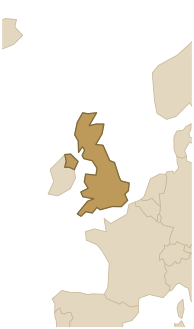
The United Kingdom is an island country off the north-west coast of Europe, separated from it by the Channel. It brings together four nations: England, Scotland, Wales and Northern Ireland, each with its own identity and sometimes its own language. Nearly 70 million people live there, around the capital, London, which was long the largest city in the world. Many of the ideas and inventions that transformed the world began on this island.
Geography
The south and east of the island are gentle plains and green countryside, the England of villages and hedgerows; the north and west are mountains and moors: the wild, misty Highlands of Scotland, the mountains of Wales, the hills of the Lake District. The sea is never far: no point in the country is more than 130 kilometres from the coast. The climate, softened by the ocean, is known for its grey skies and fine rain.
Peoples and history
The island was first Celtic, then a Roman province called Britannia. After Rome, Germanic peoples who came by sea, the Anglo-Saxons, settled there and gave England its language and its name; the Danish Vikings later carved out territory of their own. In 1066 the Norman Conquest, led by knights from France, changed the country for good. The English monarchy saw the birth of Parliament, nicknamed "the mother of parliaments". Then came the Industrial Revolution, which began here, and an Empire so vast that "the sun never set" on it, which spread English to every continent. In the 20th century its colonies became independent nations.
Language and religion
English is a Germanic language deeply changed by the French of the Normans, which gave it a double vocabulary, with Saxon words alongside words of Latin origin. Through the Empire and then the United States, it has become the world's leading international language. The country is Christian by tradition: in the 16th century Henry VIII broke with Rome and founded the Church of England, whose head is the monarch. There are also old Catholic and Presbyterian communities and, since the days of Empire, large Muslim, Hindu and Sikh communities.
Culture and way of life
Few countries have left such a mark on world culture. It is the land of Shakespeare, Dickens and Jane Austen, and of the rock of the Beatles and the Rolling Stones. It is also the country that wrote the rules of football, rugby and tennis before exporting them all over the world. People love the local pub, tea and fish and chips, and the monarchy still enjoys popular affection.