Georgia
A small mountain country between Europe and Asia, the birthplace of wine, with a language and an alphabet all its own.
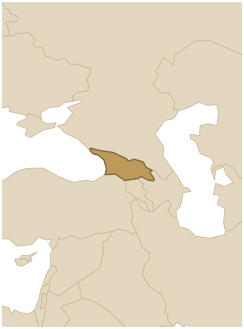
At a glance
Georgia is a mountain country in the Caucasus, between Europe and Asia, between the Black Sea to the west and the high peaks that separate it from Russia to the north. It has fewer than four million people but a very strong identity: a language and an alphabet all its own, one of the oldest Christian faiths in the world, and a great tradition of wine and feasting. In the capital, Tbilisi, houses with carved wooden balconies cling to the hillside.
Geography
The country is covered in mountains: in the north, the high Greater Caucasus range and its snowy peaks, with stone villages perched like those of Svaneti; in the south, the Lesser Caucasus. Between them lies a fertile valley of vineyards and orchards. To the west, the land drops toward the Black Sea, with a humid subtropical climate where tea and citrus fruit are grown. In a small space, Georgia goes from permanent snow to beaches.
History
The land of ancient Colchis, where the Greeks placed the Golden Fleece, Georgia was one of the very first states to make Christianity its religion, in the 4th century. In the Middle Ages it had a golden age under King David the Builder and Queen Tamar, when it ruled much of the Caucasus. Caught between the Persian, Ottoman and Russian empires, it was eventually annexed by Russia, then absorbed into the Soviet Union, whose leader, Stalin, was Georgian. Independent since 1991, it has been through several conflicts, including the 2008 war with Russia, and has applied to join the European Union.
Language and faith
Georgian belongs to none of the major language families of the region: it is part of the Kartvelian family, found only in the Caucasus, and is written in an alphabet of its own, all curves, one of the few original alphabets still in use. Georgia is an Orthodox Christian country, attached for seventeen centuries to its national church, whose monasteries and domed churches, often perched on high ground, are central to the country's identity.
Culture and way of life
Georgia is the birthplace of wine: wine was made here eight thousand years ago, in large clay jars buried in the ground, the qvevri, a method on UNESCO's intangible heritage list. Wine is at the centre of the supra, the great feast where people eat, sing and make endless toasts, led by a toastmaster, the tamada. There is also polyphonic singing in several parts and well-loved food: khinkali, dumplings full of broth, and khachapuri, bread filled with melting cheese. A proverb says that "a guest is sent by God".