Guernsey
A Channel Island off Normandy, a British Crown dependency with a Norman heritage, a land of flowers and cliffs where Victor Hugo spent his exile.
+ Guernésiais (Norman), French
At a glance
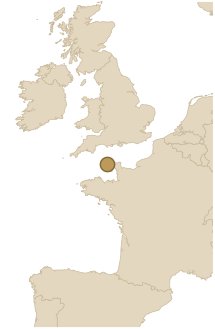
Guernsey is one of the main Channel Islands, in the English Channel, off the coast of Normandy. Like its neighbour Jersey, it is a self-governing British Crown dependency, part of neither the United Kingdom nor the European Union, with its own parliament (the States) and its own laws. About 63,000 people live on the island and its small neighbours (Alderney, Sark, Herm), around the capital, Saint Peter Port, whose steep lanes run down to the harbour. Together with Jersey, the last piece of the old duchy of Normandy still tied to England, Guernsey keeps a Norman heritage down to its language.
Geography
Guernsey is a small triangular island, tilted so that the south, lined with high, jagged cliffs and cliff paths, contrasts with the lower north, with its sandy beaches and bays. The island has a very mild, sunny climate, which once made its greenhouse crops of tomatoes and flowers prosper. The interior is a patchwork of small fields, lanes edged with low stone walls, stone houses and manors. Around it lie smaller islands: Sark, which remained feudal until 2008, tiny Herm, and Alderney further north.
History
Attached to the duchy of Normandy in the 10th century, Guernsey passed to the crown of England with the conquest of 1066; when France retook mainland Normandy in 1204, it chose, like Jersey, to stay loyal to the English king. The island lived from the sea, privateering, trade and market gardening. In the 19th century it welcomed its most famous resident: Victor Hugo, in exile, who lived there for nearly fifteen years, at Hauteville House, and wrote some of his greatest works there, including Les Misérables. Like the other Channel Islands, Guernsey was occupied by Germany during the Second World War. Now a prosperous financial centre, it keeps its centuries-old self-government.
Language and faith
The everyday language of Guernsey is English, but the island keeps its historic language, Guernésiais, a Norman dialect related to Jèrriais; once spoken every day, it is now endangered, kept alive by a few speakers and enthusiasts. French was long the official language. The island is Christian by tradition, Anglican and Methodist. Its old parishes, the traditional framework of island life, and their churches carry this heritage, in a society that is now largely secular.
Culture and way of life
Guernsey's culture mixes Norman and British heritage. It shows in the French and Norman place names, parish traditions, tales of fairies and goblins, and the memory of Victor Hugo, whose house is now a museum. The island's big celebration is the Viaer Marchi, an old-style market that brings traditions back to life. People sail, walk the cliff paths and grow flowers; the Guernsey cow is known for its rich milk. Food draws on sea and land: gâche (fruit bread), bean jar (slow-cooked beans), seafood, butter and cream.