Ghana
The former Gold Coast, land of gold and of the Ashanti kingdom, one of the very first countries in sub-Saharan Africa to win independence.
+ Twi (Akan), Ewe, Ga…
among the first in sub-Saharan Africa
At a glance
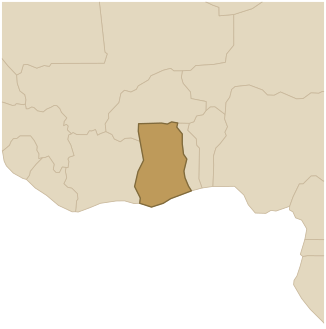
Ghana lies on the Gulf of Guinea, in West Africa, from its Atlantic coast to the savannas of the north. About 34 million people live there; the capital is Accra. Long called the "Gold Coast" for its riches, the country has a special place in the continent's history: in 1957 it was one of the very first countries in sub-Saharan Africa to win independence, and it became a symbol of hope for all of Africa. Today it is one of the most stable democracies in the region.
Geography
The land slopes gently down to the sea. In the south, the coast is lined with beaches and lagoons; inland lies humid rainforest, where cocoa, one of the country's great sources of wealth, is grown. Further north the forest gives way to vast, drier savannas. In the middle lies Lake Volta, one of the largest artificial lakes in the world, held back by a huge dam. The ground holds gold and, more recently, oil.
Peoples and history
The heart of Ghana is the Akan world, whose most famous kingdom was that of the Ashanti, powerful and refined, united around its sacred "Golden Stool" and enriched by the trade in gold and kola nuts. On the coast, Europeans (Portuguese, Dutch, British) built a chain of forts, such as Elmina, first for gold and then for the slave trade to the Americas. The British eventually subdued the Ashanti and made the country a colony. In 1957, led by Kwame Nkrumah, a leading figure of pan-Africanism, Ghana won its independence and opened the way for many other African countries.
Languages and religion
Some eighty languages are spoken in Ghana; the most widespread are the Akan languages, including Twi, along with Ewe and Ga. English, inherited from colonial rule, is the official and common language. The country is mostly Christian, especially in the south, with very fervent churches, while the north is largely Muslim; traditional beliefs are still alive, with libations to the ancestors and their symbols.
Culture and way of life
Ghanaian culture is rich in colour and symbols. Kente, a cloth woven in strips with bright patterns, once reserved for Ashanti kings, has become an emblem for all of Africa and its diaspora. Each adinkra symbol stands for a proverb or an idea. Music, from highlife to today's afrobeats, keeps the whole region dancing, and Ghana argues with neighbouring Nigeria over who makes the best jollof, a spicy rice dish.