Gibraltar
A British rock at the southern tip of Spain, guarding the strait between Europe and Africa, home to people from all around the Mediterranean and to the only wild monkeys in Europe.
+ Spanish, Llanito
claimed by Spain
At a glance
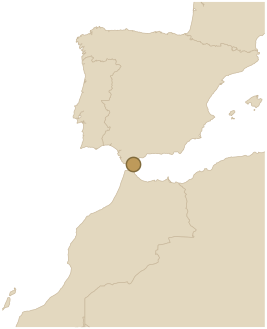
Gibraltar is a tiny British territory at the southern tip of the Iberian Peninsula, at the mouth of the Mediterranean, about fifteen kilometres from Morocco. Dominated by a great limestone Rock, this overseas territory guards one of the most strategic points in the world: the strait that links the Atlantic to the Mediterranean and separates Europe from Africa. About 34,000 people live at the foot of the Rock. Gibraltarians, of very mixed origins, are British by nationality and Mediterranean by culture. Claimed by Spain, Gibraltar has voted overwhelmingly to remain British.
Geography
Gibraltar is first of all its Rock, a limestone headland over four hundred metres high rising out of the sea, joined to Spain by a sandy plain crowded with the town and the airport. The Rock, riddled with caves and tunnels dug during sieges, drops in cliffs to the Mediterranean. Barbary macaques, the only wild monkeys in Europe, live on its upper slopes. From the top you can see two continents and two seas. Short of space, the very crowded town has reclaimed land from the sea and built upward. The Mediterranean climate is mild and sunny.
History
Known to the ancients as one of the "Pillars of Hercules", the Rock was, in 711, the landing place of the Berber commander Tariq ibn Ziyad during the Muslim conquest of Spain: the name comes from him, Jebel Tariq, "Tariq's mountain". A Moorish and then Spanish stronghold, Gibraltar was captured in 1704 by an Anglo-Dutch fleet and ceded to Britain by the Treaty of Utrecht in 1713. Thought impregnable after holding out through long sieges, the Rock became a major British naval base, and its population grew through immigration from all over the Mediterranean. Despite the claim of Spain, which closed the border from 1969 to 1985, Gibraltarians have repeatedly voted to stay British.
Language and faith
The official language of Gibraltar is English, but almost everyone also speaks Spanish, as well as a local dialect, Llanito, a mix of Andalusian Spanish, English and words from all around the Mediterranean, one of the hallmarks of Gibraltarian identity. Religions coexist in this small territory: Catholicism, the majority faith, sits alongside Anglicanism, an old Sephardic Jewish community, Muslims and Hindus, all long established. Churches, synagogues and a mosque stand a few streets apart.
Culture and way of life
Gibraltarian culture is both British and Mediterranean: pubs, red phone boxes and bobbies sit alongside the siesta, southern cooking and life lived in the street. Llanito is its most living symbol. On National Day the whole Rock dresses in red and white, and Catholic processions mark the year. The food reflects the population's origins: calentita, a chickpea flatbread of Genoese origin, is the national dish, with Spanish, Italian, Maltese, English and North African influences.