Guinea
The "water tower of West Africa", where great rivers rise, home of the Fulani and Mande peoples and one of the cradles of the Mali empire.
+ French
At a glance
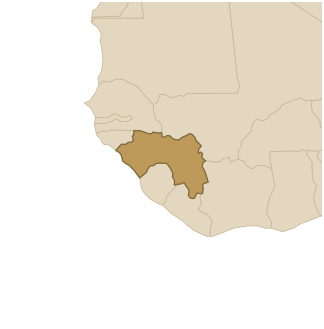
Guinea is a country in West Africa, on the Atlantic, with green, mountainous landscapes. It is called the "water tower of West Africa": several of the region's great rivers, including the Niger, rise in its highlands. Fourteen million people live there, from several large peoples (Fulani, Malinke, Susu), around the capital, Conakry. The ground is very rich, especially in bauxite, and the country was one of the cradles of the great medieval empire of Mali.
Geography
Guinea has four distinct regions. The coast, or Lower Guinea, hot and humid, is lined with mangroves around Conakry. In the centre, the Fouta Djallon massif forms cool, green highlands cut by waterfalls, where the rivers begin. To the east, Upper Guinea is savanna where the Niger rises. To the south-east, Forest Guinea is covered in dense rainforest and mountains, including Mount Nimba, a reserve of great biodiversity.
History
Guinea was one of the cradles of the great Mali empire, whose legendary founder, Sundiata Keita, is still sung by the griots. In the 18th century the Fouta Djallon became an influential Fulani Muslim state. In the late 19th century, the almami Samory Touré led one of the longest resistances to French colonial conquest. In 1958, led by Sékou Touré, Guinea was the only territory to vote "No" in General de Gaulle's referendum and chose immediate independence ("We prefer poverty in freedom to riches in slavery"), at the cost of a brutal break with France. The country then went through Sékou Touré's long dictatorship and several coups, the most recent in 2021.
Languages and faith
Guinea has many languages: Fulani (Pular), Malinke, a Mande language, and Susu are the most widely spoken; French, inherited from colonisation, is the official and common language. The country is overwhelmingly Sunni Muslim, with an old and deeply rooted Islam, especially in the Fouta Djallon, long a great centre of Islamic learning; Christian minorities and traditional religions remain, mainly in the forest region.
Culture and way of life
Music has a huge place in Guinean culture. It is the land of the djembe and of the great dance companies, including Les Ballets Africains, which made Mande dance and drumming known around the world. It is the world of the griots, masters of the spoken word and the kora, who hand down the memory of empires and families from one generation to the next. There are also crafts, textiles and forest masks. The staple is rice, served with leaf or peanut sauces.