Guadeloupe
A butterfly-shaped French archipelago in the Antilles, a land of beaches, a volcano and rainforest, with a Creole society born of slavery and the mixing of peoples.
largest city: Pointe-à-Pitre
At a glance
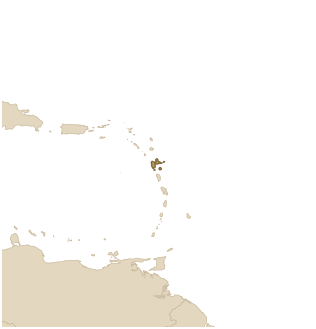
Guadeloupe is a French archipelago in the Antilles, in the Caribbean Sea; an overseas department and region, it is fully part of France and of the European Union. Its two main islands, separated by a narrow channel, form the shape of a butterfly: Grande-Terre, flat and made of limestone, and Basse-Terre, mountainous and volcanic; there are also smaller islands such as Marie-Galante and Les Saintes. Nearly 380,000 people live there; Guadeloupe's Creole people grew out of slavery and the meeting of several continents. Beaches, rum and music give the island its reputation.
Geography
The butterfly's two wings are very different. Grande-Terre, to the east, is low, dry limestone country, lined with white-sand beaches and turquoise lagoons, where most of the tourism is. Basse-Terre, to the west, is mountainous and wet, covered in rainforest protected by a national park and dominated by the La Soufrière volcano, "the old lady", the highest point in the Lesser Antilles, which still steams. Waterfalls, rivers and rich sea life draw nature lovers. The climate is tropical, hot and humid, with a rainy season and hurricanes.
History
First home to Arawak and then Kalinago (Carib) Amerindians, who called it Karukera, "island of beautiful waters", Guadeloupe was reached by Christopher Columbus in 1493. French colonisation, from 1635, wiped out the native peoples and set up a sugar plantation economy built on the mass deportation of enslaved Africans. A first abolition, in 1794, was overturned by Bonaparte in 1802; slavery was finally abolished only in 1848. Indentured workers were then brought from India. Long a colony, Guadeloupe became a French department in 1946. The memory of slavery and social struggles are central to its Creole identity.
Language and faith
Guadeloupeans speak French, the official language, and, day to day, Guadeloupean Creole, born on the plantations, French-based with African elements. The island is mostly Catholic, a faith brought by colonisation, with its festivals and processions. Beliefs and practices from Africa often mix with it, and there is also a Hindu community, descended from the Indian indentured workers, and a Protestant one.
Culture and way of life
Guadeloupean culture is Creole and Caribbean, born of the meeting of Africa, Europe and India. There is gwoka, drum music and dance handed down from the slaves, at the heart of the island's identity and on UNESCO's intangible heritage list, and carnival, a huge popular celebration. There is zouk, Caribbean literature and the art of storytelling. The food is spicy: colombo (a Caribbean curry), saltfish fritters, Creole black pudding, the bokit, rhum agricole and tropical fruit.