The Gambia
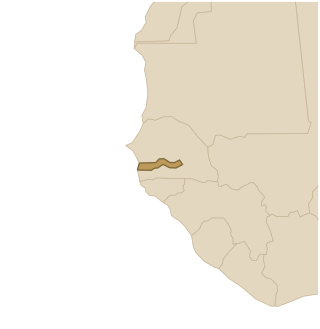
The smallest country on mainland Africa, a thin strip of land along a river, nicknamed Africa's "smiling coast", and a place of memory of the slave trade.
+ English
At a glance
The Gambia is the smallest country on mainland Africa, and one of the oddest shapes on the map: a narrow strip of land that runs several hundred kilometres into Senegal, on both banks of the Gambia River, following its course. About 2.7 million people live there, from several West African peoples, around the capital, Banjul, at the river mouth. Nicknamed "the smiling coast of Africa" and known for its beaches, The Gambia also carries the memory of the Atlantic slave trade.
Geography
The whole of The Gambia is built around its river, one of the most navigable in Africa, which runs across it from east to west. Its banks are lined with mangroves, marshes and wetlands full of birds. Inland, scrubby savanna dominates. At the river mouth and on the Atlantic coast, sandy beaches fringed with coconut palms draw tourists.
History
From the Middle Ages, the Gambia River was a major trade route, within the orbit of the Mali empire. From the 15th to the 18th century it also became a route of the Atlantic slave trade: on a small island in the river, now called Kunta Kinteh Island and a World Heritage Site, captives were shipped to the Americas. The island became famous through Alex Haley's book Roots, which traced his family back to it. A British colony surrounded by French Senegal, The Gambia became independent in 1965. After more than twenty years of authoritarian rule by Yahya Jammeh, the country saw a democratic change of power in 2017.
Languages and faith
The Gambia has several languages: Mandinka, Fula, Wolof and Soninke are the most widely spoken, and English, inherited from colonial rule, is the official language. The country is overwhelmingly Sunni Muslim, with an old Islam often shaped by the region's Sufi brotherhoods, and a Christian minority and traditional practices. Religious holidays and respect for elders set the rhythm of social life.
Culture and way of life
Gambian culture belongs to the Mandinka and Wolof world of West Africa, rich in music and the spoken word. It is the world of the griots (jali), who keep the memory of families and play the kora, a twenty-one-string harp-lute born in this region. Traditional wrestling is hugely popular, along with bright fabrics, drums and festival dances. People eat rice, peanuts, the country's great crop, fish from the river and the sea, and domoda, a peanut stew.