Guinea-Bissau
A small Portuguese-speaking country of rivers and islands on the Atlantic coast, home to many peoples and to the wild Bijagós archipelago.
+ local languages
At a glance
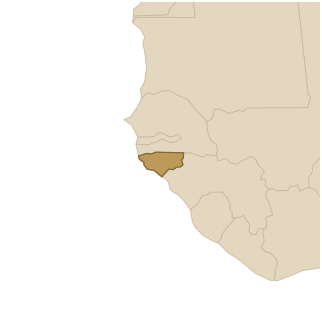
Guinea-Bissau is a small country in West Africa, on the Atlantic coast, between Senegal and Guinea. A former Portuguese colony, it is one of the few Portuguese-speaking countries on the continent. About two million people live there, from many different peoples, around the capital, Bissau. The coast is cut up by rivers and mangroves and continues offshore into a large archipelago, the Bijagós. Poor and fragile, often shaken by political instability, Guinea-Bissau keeps a rich cultural life and a natural world that is still wild.
Geography
Guinea-Bissau is a low, wet country where land and water mix. The coast is a maze of estuaries, mangroves and inlets, crossed by rivers that run far inland. Offshore, the Bijagós archipelago gathers dozens of wild islands, a UNESCO biosphere reserve, home to hippos that swim in the sea, turtles and countless birds, and to a very distinctive traditional society. The flat interior alternates between savanna, gallery forest and rice fields.
History
Once within the orbit of the Mali empire, the coast was, from the 15th century, one of the first places in Africa where the Portuguese made contact, and a site of the Atlantic slave trade. As "Portuguese Guinea", the region fought one of the most effective liberation wars in Africa, led by the pan-African thinker Amílcar Cabral, who was assassinated in January 1973, a few months before independence was proclaimed. The young country's history has since been marked by coups and chronic instability.
Languages and faith
The official language is Portuguese, but the language that holds the country together is Guinea-Bissau Creole (Kriol), born of Portuguese and African languages and spoken by almost everyone; alongside it are the languages of the different peoples, such as Balanta, Fula and Mandinka. Religion is very varied: Islam, the most widespread by most estimates, especially inland, Christianity, and traditional religions, which remain very strong, notably in the Bijagós, where initiation rites and respect for the spirits still set the rhythm of life.
Culture and way of life
Bissau-Guinean culture is lively and mixed. There is gumbé, the upbeat national rhythm born of the mixing of peoples, and drumming everywhere. There are the traditions of the Bijagós, a society in which women play a central role, with bull masks, dances and initiation rites. There are crafts, carving and textiles. The staple is rice, grown in the mangroves, with fish and palm oil; cashew nuts are the country's great source of income.