Equatorial Guinea
A small Central African country of mainland and islands, the only one in Africa with Spanish as its official language, a land of equatorial forest and oil.
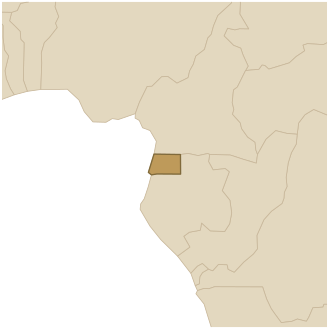
future capital: Ciudad de la Paz
+ Fang, Bubi
At a glance
Equatorial Guinea is a small country in Central Africa, spread across the mainland and islands in the Gulf of Guinea. It is the only country in Africa whose main official language is Spanish, the legacy of Spain's only colony in sub-Saharan Africa. Its capital, Malabo, is not on the mainland but on a volcanic island, Bioko. Fewer than two million people live there, mostly Fang. Thanks to oil, the country has one of the highest incomes per head in Africa, but it is ruled with an iron hand and its wealth does little for most of its people.
Geography
The country comes in two parts. The mainland, Río Muni, is covered in thick, hot, humid equatorial forest, crossed by rivers and home to gorillas, chimpanzees and forest elephants. Offshore lie several volcanic islands: Bioko, mountainous and fertile, with beaches where turtles nest and highland forests, and Annobón, tiny and remote in the South Atlantic. The equatorial climate brings heavy rain and very dense vegetation.
History
The territory was settled through the Bantu migrations, including those of the Fang on the mainland and the Bubi on Bioko. The Portuguese arrived first, then ceded the islands to Spain in 1778, hence the Spanish language. Independent in 1968, the country fell at once under the terrible dictatorship of Macías Nguema, one of the bloodiest in Africa. His nephew, Teodoro Obiang, who overthrew him in 1979, has ruled ever since, one of the longest reigns in the world. The discovery of oil in 1996 transformed the economy without really changing life for most people.
Languages and faith
Equatorial Guinea has three official languages: Spanish, very widely spoken, French, added to bring the country closer to its neighbours, and Portuguese. Alongside them are the languages of its peoples, such as Fang and Bubi, both Bantu languages, and a Portuguese creole on Annobón. The country is mostly Christian, above all Catholic, a legacy of Spanish rule and the missions, with Bantu traditions and respect for the ancestors in the background.
Culture and way of life
Equatoguinean culture mixes a Bantu heritage with a Spanish touch that is rare in Africa. There is music and dance, such as the balélé and the Fang ibanga, in which dancers coat their bodies with kaolin, along with drums and singing. There are masks and statues from the great Fang tradition, which left its mark on African art. The food mixes African and Spanish flavours: fish, pepesup (a peppery soup), chicken in peanut sauce, cassava and tropical fruit.