Greece
The birthplace of democracy, philosophy and theatre, a land of sea and of thousands of sunlit islands.
~6,000 islands
war begun in 1821
At a glance
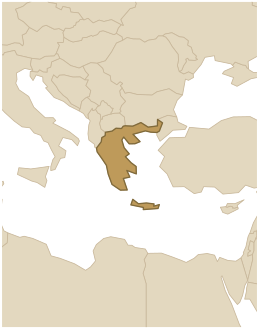
Greece occupies the southern tip of the Balkans, on the Mediterranean, continued by thousands of islands in the Aegean and Ionian seas. The sea is never far away, and it shaped everything: the ancient Greeks used it to travel, trade and found colonies all around the Mediterranean. About ten million people live there today, around the capital, Athens. Much of European culture was born here.
Geography
Greece is a country where mountains and sea are woven together. Rocky ranges cover almost the whole mainland, including Mount Olympus, home of the gods in mythology, leaving few plains. Everywhere the mountains drop into a deep blue sea, carving out endless coastlines and strings of islands: the whitewashed Cyclades, great Crete, Santorini and its volcanic caldera. Under a strong sun grow olives, vines and citrus fruit, among ancient ruins.
History
Ancient Greece invented part of our world. In its cities, above all Athens, were born democracy, the philosophy of Socrates, Plato and Aristotle, theatre, history, the Olympic Games, and sculpture and architecture that are still models today. Alexander the Great then carried this culture as far as India. For a thousand years Greece was the heart of the Byzantine Empire, Christian and Greek-speaking, centred on Constantinople. After nearly four centuries of Ottoman rule, the Greeks rose up in 1821 and won their independence in 1830.
Language and religion
Greek is one of the oldest written languages still spoken: it has been written without a break for nearly three thousand years, in its own alphabet. Many of our words (democracy, philosophy, tele-, bio- and many more) come straight from it. The country is strongly attached to the Greek Orthodox Church, heir to Byzantium, whose festivals, icons and monasteries, such as the rock-top monasteries of Meteora or those of Mount Athos, shape life and national identity.
Culture and way of life
Greece is one of the homes of the Mediterranean way of life. The Cretan diet, said to be one of the healthiest in the world, is built on olive oil, vegetables, fish, feta and yoghurt; in the tavernas people share mezze, souvlaki and moussaka. There is the sirtaki and the sound of the bouzouki, and hospitality, philoxenia, "love of the stranger".