Grenada
The "Spice Isle" of the Lesser Antilles, a land of nutmeg and volcanic forest, whose people are mostly of African descent.
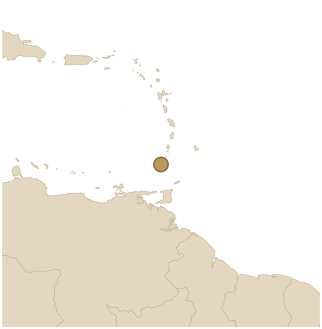
+ Grenadian Creole
At a glance
Grenada is a small volcanic island in the Lesser Antilles, at the far southern end of the Caribbean chain, along with a few smaller islands. It is nicknamed the "Spice Isle": it is one of the world's largest producers of nutmeg, which even appears on its flag. A little over 100,000 people live there, the great majority of African descent, around the capital, St George's, often called one of the prettiest harbours in the Caribbean. The island, covered in forests, waterfalls and beaches, has had a turbulent history.
Geography
Grenada is a volcanic island, mountainous and very green. Its interior is covered in dense rainforest, with waterfalls, crater lakes such as Grand Étang, and hot springs; spices are grown on the slopes. The coasts have fine sandy beaches, including the famous Grand Anse, and well-known dive sites, with an underwater sculpture park. The climate is tropical, hot and humid; the island lies on the southern edge of the hurricane belt and is hit less often than its northern neighbours, but Ivan in 2004 and Beryl in 2024 did heavy damage.
History
Home to Amerindian peoples, the island was colonised first by the French and then by the English, who grew sugar and later spices using enslaved Africans, the ancestors of today's population. After abolition and more than a century of British rule, Grenada became independent in 1974. It then went through a socialist revolution and, in 1983, after the murder of its leader Maurice Bishop, a United States military intervention. The country has since returned to stability and democracy.
Language and faith
The official language is English, but day to day Grenadians speak an English-based creole with a few traces of the old French creole. The country is strongly Christian, divided between Catholicism, a French legacy, and Protestant churches, an English legacy; faith plays a big part in social life. As everywhere in the Caribbean, traditions of African origin persist in the background.
Culture and way of life
Grenadian culture is Afro-Caribbean. Its big event is Spicemas, the summer carnival, with traditional characters such as the Jab Jab, devils smeared with oil and black molasses in memory of slavery, and parades of calypso and soca. Spices (nutmeg, mace, cinnamon, cloves) flavour the food and fill the markets. The national dish is oil down, a stew of breadfruit, salted meat and coconut milk cooked outdoors in a big pot. The sea and cricket also loom large.