Guatemala
The heart of the Maya world, a land of volcanoes and forests, where Indigenous culture is more alive than almost anywhere else in the Americas.
"Ciudad de Guatemala"
+ ~20 Maya languages
At a glance
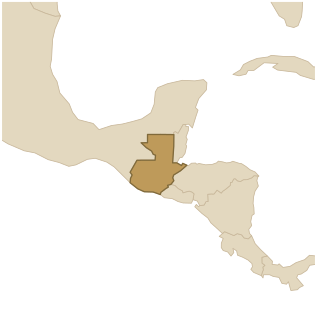
Guatemala lies at the heart of Central America, the isthmus linking the two Americas, with coasts on both the Pacific and the Caribbean. It is the most populous country in the region, and the most Indigenous: the Maya world lives on here, in its languages, clothing, markets and beliefs, and more than four in ten people identify as Maya. Eighteen million people live in this land of volcanoes and forests, around the capital, Guatemala City.
Geography
A chain of volcanoes, several still active, runs across the south of the country in a line of near-perfect cones; some tower over Lake Atitlán, ringed by Maya villages. These cool, fertile volcanic highlands are home to most of the population and grow well-known coffee. To the north lies the hot, humid lowland of Petén, covered in rainforest, where ancient Maya cities such as great Tikal lie hidden under the vegetation.
History
Guatemala was one of the centres of Maya civilisation. In the forests of Petén rose great city-states with pyramids taller than the trees, such as Tikal; the Maya mastered writing, astronomy and a highly precise calendar. After a decline whose causes are still debated, the region was conquered by the Spanish in 1524. Colonial rule was harsh for Indigenous peoples, but, being numerous, they kept their languages and traditions. Independent from 1821, the country went through a civil war from 1960 to 1996 that killed more than 200,000 people, most of them Maya.
Languages and religion
Guatemalans speak Spanish, but also some twenty Maya languages (K'iche', Kaqchikel, Mam and many others), spoken by millions: it is one of the countries in the Americas where Indigenous languages are most alive. Most people are Catholic, with a fast-growing evangelical population, and among the Maya faith is often mixed with ancient rites: in some places people still pray to the old gods alongside the Christian saints.
Culture and way of life
Guatemala is known for its colour, carried by Maya tradition. Women weave and wear the huipil, a blouse embroidered with bright patterns that differ from village to village. Indigenous markets, such as Chichicastenango, overflow with textiles, flowers and smells. The marimba, a large wooden xylophone, plays at every festival. Maize dominates the table, as tortillas and tamales, with black beans and chilli. The colonial town of Antigua, at the foot of its volcanoes, is a World Heritage Site.