French Guiana
A vast French territory in South America almost entirely covered by Amazon rainforest, where Europe launches its rockets, with a very diverse population.
the largest French region
+ Amerindian and Bushinengue languages
At a glance
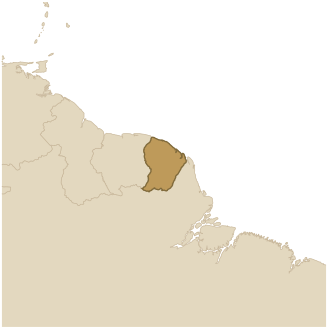
French Guiana is a vast French territory on the South American mainland, between Brazil and Suriname; an overseas department and region, it is fully part of France and of the European Union. It is the largest French region but one of the least populated: about 300,000 people, mostly on the coast, because the interior is almost entirely covered by Amazon rainforest. The population is very diverse: Creoles, Amerindians, Bushinengue (descendants of escaped slaves), Hmong, Brazilians, Haitians and people from mainland France. It is also home to the Kourou Space Centre, from which Europe launches its rockets.
Geography
French Guiana is a land of forest: the great Amazon rainforest covers almost all of it, with very rich biodiversity, crossed by powerful rivers (the Maroni, the Oyapock), which are the only routes into the interior. Life is concentrated on the narrow Atlantic coast, among mangroves, marshes and savannas, where Cayenne and the other towns lie. The equatorial climate is hot and very humid. Jaguars, leatherback turtles and a wealth of other wildlife find refuge here.
History
A land of Amazonian Amerindian peoples, French Guiana was colonised by France in the 17th century, with plantations and slavery; escaped slaves, the Maroons, founded Bushinengue societies in the forest that still exist. In the 19th century France set up its penal colony there: tens of thousands of convicts, including Dreyfus on Devil's Island, were sent there and lived in appalling conditions until it closed in 1953. French Guiana became a French department in 1946. In 1968 the Kourou Space Centre, well placed near the equator, began launching rockets and made the territory Europe's spaceport.
Language and faith
People speak French, the official language, and the widely used, French-based Guianese Creole, but also many other languages: Amerindian languages, Bushinengue languages (Nengee), Portuguese, Hmong and Chinese. Catholicism dominates, a legacy of colonisation, alongside strong evangelical communities, Amerindian beliefs and, among the Bushinengue, spiritual traditions from Africa.
Culture and way of life
Guianese culture is a crossroads of peoples and traditions. There is Carnival, one of the longest in the world, with its famous touloulous, disguised and masked women who lead the dances; there are the arts and knowledge of Amerindian peoples, finely patterned Bushinengue textiles and carvings, and the Hmong traditions of inland villages. The food mixes all these strands: awara broth, the emblematic Easter dish, colombo curry, smoked fish, game and forest fruit.