Guyana
A country of forests and giant waterfalls on the north coast of South America, the only one on the continent with English as its official language, where India, Africa and the Americas meet.
+ Guyanese Creole
At a glance
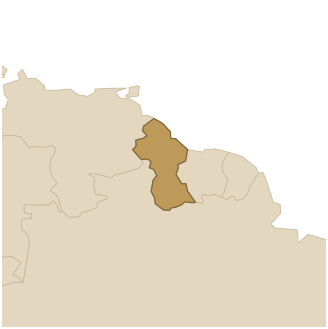
Guyana is a country on the north-east coast of South America, on the Atlantic, between the continent and the Caribbean world. It is the only country in South America with English as its official language, and its culture ties it more to the Caribbean than to its Spanish-speaking neighbours. Thinly populated, with about 800,000 people, mostly around the capital, Georgetown, on the coast, it is also one of the most mixed countries in the world: people of Indian, African and Amerindian descent live side by side. Long very poor, it has been transformed since 2015 by the discovery of huge oil reserves.
Geography
The country's name is said to mean "land of waters", and it fits: Guyana is a country of great rivers, forests and waterfalls. Vast, almost untouched rainforest covers most of it, home to jaguars, giant otters and macaws. In the middle of it, Kaieteur Falls, one of the most powerful single-drop waterfalls in the world, nearly five times the height of Niagara, plunges into the forest. In the south lie savannas. Most people live on the narrow coastal plain, partly reclaimed from the sea and protected by dykes, as in the Netherlands.
History
Home to Arawak and Carib Amerindians, the region was first colonised by the Dutch, who built the coastal dykes, and later passed to the British. The colonists set up sugar plantations based on African slavery. After abolition, as in Trinidad or Fiji, some 240,000 indentured workers were brought from India, and their descendants now make up about four in ten of the population. This mix produced an original society, but also tensions between the Indian and Afro-Guyanese communities. The country became independent in 1966.
Languages and faith
The official language is English, but day to day people speak Guyanese Creole, alongside Amerindian languages and some Hindi inherited from the indentured workers. Religion reflects the country's mix: Christianity, Hinduism and Islam, the last two brought by the Indians, live side by side, and each community's great festivals, such as Diwali and Phagwah (Holi), are national holidays.
Culture and way of life
Guyanese culture blends the Caribbean and India. The food brings these worlds together: Indian curry and roti, Amerindian pepperpot (a stew slow-cooked in cassareep, a cassava extract), rice and seafood. In music there is soca, chutney, an Indo-Caribbean blend, and reggae; among festivals, carnival and Diwali, which lights up Georgetown. The capital keeps its colonial wooden houses and its cathedral, one of the tallest wooden churches in the world.