Honduras
A country of mountains and coasts between two seas in Central America, home of the Maya ruins of Copán and of Caribbean reefs.
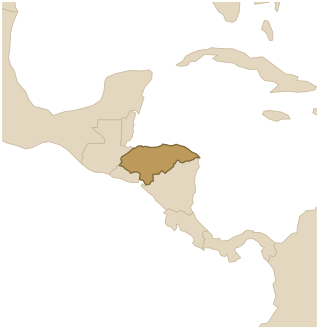
At a glance
Honduras is a country in Central America, with the Caribbean Sea to the north and a short stretch of Pacific coast to the south. It is a land of forested mountains, home to about ten million people; the capital is Tegucigalpa. The country carries the heritage of the Maya, whose city of Copán was one of their great centres, and its people mix Indigenous groups, descendants of Spaniards and Afro-Caribbean communities.
Geography
Three-quarters of Honduras is mountainous: an interior of ranges and valleys covered in pine and cloud forest, with a climate cooled by altitude. To the north lies a hot coastal plain facing the Caribbean, with the Bay Islands offshore and part of the second-largest barrier reef in the world, popular with divers. To the east, the Mosquitia, a region of primeval forest, swamps and rivers, is one of the last great wild areas in Central America. The country lies in the path of Caribbean hurricanes.
History
On the southern edge of the Maya world, Honduras was home to one of its most refined cities, Copán, known for its carved stelae and its staircase covered in hieroglyphs, now a World Heritage Site. After Columbus passed by in 1502 and the Spanish conquest, the country became independent in 1821. In the 20th century its economy was dominated by large American banana companies, to the point that Honduras inspired the term "banana republic". The country has since gone through instability, dictatorships, high levels of violence and heavy emigration.
Language and faith
Hondurans speak Spanish; on the Caribbean coast and the Bay Islands, an English-based creole survives, along with the languages of Indigenous and Afro-descendant peoples. Among them the Garifuna, descendants of Africans and Carib Amerindians, have kept their own language and culture. The country is mostly Catholic, with fast-growing evangelical churches, and popular faith mixes in places with older traditions.
Culture and way of life
Honduran culture is mixed. There is the Maya heritage of Copán, Indigenous Lenca roots, and the culture of the coastal Garifuna, whose punta music, dances and language are on UNESCO's intangible heritage list. People eat the baleada, a wheat tortilla folded over beans and cheese, the national snack, as well as maize and tropical fruit. Football and the marimba are hugely popular.