Croatia
A crescent-shaped country on the Adriatic, with over a thousand islands and white-stone towns, where Central Europe meets the Balkans.
since 2023
At a glance
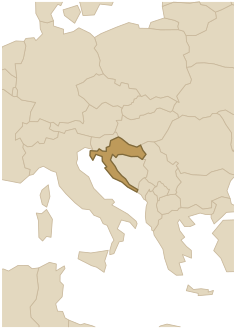
On the map, Croatia forms a crescent between Central Europe and the Adriatic Sea, with nearly 1,800 kilometres of coastline, not counting the islands. It has two sides: inland, plains and hills around the capital, Zagreb; along the sea, Dalmatia, with its white-stone towns and its islands. Just under four million people live there. Croatia sits where the Germanic, Latin and Slavic worlds meet, between Central Europe and the Mediterranean.
Geography
The Croatian coast is one of the best known in Europe: deep blue water, coves, cliffs and more than a thousand islands, only a few dozen of them inhabited. Behind it rise the bare mountains of the Karst, limestone riddled with caves and underground rivers. Inland the country turns green and gentle: the fertile plains of Slavonia, hills and vineyards, forests and lakes, including the turquoise cascades of Plitvice.
History
Illyrian and then Roman (the emperor Diocletian built his palace at Split), the region was settled in the 7th century by the Croats, a Slavic people who adopted Latin Christianity. The kingdom of Croatia, founded in the 10th century, joined the crown of Hungary in 1102 and later passed to the Habsburgs, while the Dalmatian coast long remained under Venice. In the 20th century Croatia was one of the republics of socialist Yugoslavia. It declared independence in 1991 and had to defend it in a war that lasted until 1995. It joined the European Union in 2013 and adopted the euro in 2023.
Language and faith
Croatian is a South Slavic language, very close to Serbian and Bosnian; it differs from them mainly in using the Latin alphabet (Serbian also uses Cyrillic) and in part of its vocabulary. Croatia is overwhelmingly Catholic, which sets it apart from its Orthodox and Muslim neighbours and has tied it to Central Europe and Rome since the Middle Ages.
Culture and way of life
Croatian culture mixes the Mediterranean and Central Europe. On the coast there are the white-stone towns (Dubrovnik, the walled "pearl of the Adriatic", and Split with Diocletian's palace), grilled fish, olive oil and wine. Inland the feel is more continental, closer to Vienna and Budapest. The necktie comes from Croatia (its French name, cravate, derives from "Croat"), and the physicist Nikola Tesla was born on Croatian soil.