Haiti
The world's first Black republic, born of the only slave revolt that ever founded a state, a Caribbean land of art and vodou.
First free Black state
At a glance
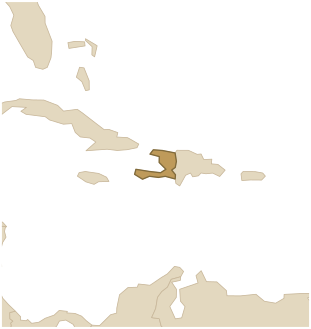
Haiti covers the western third of the island of Hispaniola, in the Caribbean, which it shares with the Dominican Republic. It is a small, mountainous country: its name, inherited from the Taíno, its first inhabitants, means "land of high mountains". Haiti is the world's first Black republic and the only country born of a successful slave revolt. Nearly twelve million people live there; the capital is Port-au-Prince.
Geography
As its name says, Haiti is a country of mountains: steep ranges cover most of it, with fertile plains and valleys between them where farming is concentrated. It has a long Caribbean coast, beaches and a few islands, such as Gonâve and Tortuga. The tropical climate, hot all year, leaves it exposed to Atlantic hurricanes, and the island is also prone to earthquakes, like the one in 2010 that killed more than two hundred thousand people. Deforestation has worn away the soil on these mountains.
History
After the Taíno, the first inhabitants, had died out, the western part of the island became a French colony in 1697: Saint-Domingue. In the 18th century it was the richest colony in the world, the "pearl of the Antilles", supplying much of the sugar and coffee consumed in Europe. That wealth rested on the enslavement of hundreds of thousands of Africans, in atrocious conditions. In 1791 the enslaved rose up; led by Toussaint Louverture and then Dessalines, they defeated the army Napoleon sent against them and declared Haiti's independence in 1804, the first state founded by people who had been enslaved. France only recognised it in 1825, in return for a heavy indemnity that weighed on the country for more than a century. Since the assassination of President Jovenel Moïse in 2021, Haiti has been in a deep political crisis, and armed gangs control much of the capital.
Language and religion
Almost all Haitians speak Haitian Creole, a language in its own right, born of the settlers' French and the languages of West Africa; it has been an official language alongside French since 1987, though French still dominates in schools and government. Religion has two intertwined sides: Catholicism, inherited from colonial rule, and vodou, an Afro-Haitian religion born among the enslaved, which honours spirits, the lwa, drawn from West African faiths. Long caricatured and persecuted, vodou has been recognised as a religion since 2003, and many Haitians practise it while also being Catholic. Evangelical churches have grown a great deal too.
Culture and way of life
Haitian painting, with its bright colours, is known around the world, and the country's literature, in French and Creole, runs from Jacques Roumain to Dany Laferrière. Its music, from compas to the rhythms of carnival and vodou, is made for dancing. The food combines rice, beans, plantain and spices; soup joumou, eaten on 1 January to celebrate independence, is on UNESCO's intangible heritage list. A large diaspora in the United States, Canada, France and the Caribbean carries the culture too.