Hungary
The country of the great plain and the Danube, settled by Magyar horsemen from the east, home of Budapest and paprika.
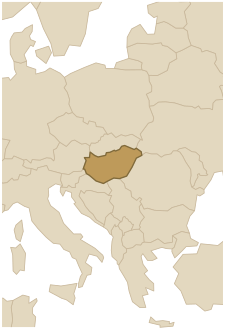
At a glance
Hungary is a landlocked country in Central Europe, spread around a vast plain crossed by the Danube. Its language, Hungarian, sets it apart from all its neighbours: it is not Indo-European. The Hungarians, or Magyars, descend in part from a people of horsemen who came from the eastern steppes more than a thousand years ago and settled in the heart of Europe. Nearly ten million people live there; the capital, Budapest, is split in two by the river.
Geography
Hungary is above all the country of the great plain, the puszta: vast flat grasslands, once crossed by herds and horse-herders, that recall the steppes the ancestors came from. The Danube runs through the country from north to south and, in Budapest, divides the hills of Buda from the flat ground of Pest. To the west lies Lake Balaton, the "Hungarian sea", the largest lake in Central Europe. The soil is rich: wheat, maize and vines.
History
Around 896 the Magyar tribes, feared horsemen from the Eurasian steppes, settled on the Danube plain. In the year 1000 their ruler Stephen, baptised as a young man, was crowned king and made Hungary a Christian kingdom. A great medieval state, it was broken by the Ottomans at Mohács in 1526 and split in three; the Habsburgs took back the whole of it at the end of the 17th century. In 1867 Hungary became Austria's equal within the Austro-Hungarian Empire. After the First World War the Treaty of Trianon (1920) took away two-thirds of its territory; after the Second it went through communism and the crushing of the 1956 uprising, before regaining its freedom in 1989. It has been a member of the European Union since 2004.
Language and faith
Hungarian (magyar) stands apart in Europe: it does not belong to the Indo-European family but to the Finno-Ugric family. Its closest relatives are Khanty and Mansi, spoken in western Siberia; Finnish and Estonian are distant cousins. Hungary has a Christian tradition, mostly Catholic with a large Protestant (Calvinist) minority, and a growing share of the population says it has no religion.
Culture and way of life
Hungarian culture joins the legacy of the steppe horsemen with that of Central Europe. In music there are the Romani violinists, but also Liszt, Bartók and Kodály, who collected peasant songs. In the kitchen there is paprika, the mild pepper that colours and flavours almost everything, starting with goulash, the national soup-stew, and there is Tokaj wine. And there are the thermal baths, a legacy of the Romans and the Ottomans, of which Budapest has many.