Indonesia
The world's largest archipelago, thousands of islands strung along the equator, the country with the most Muslims on Earth and home to several hundred peoples.
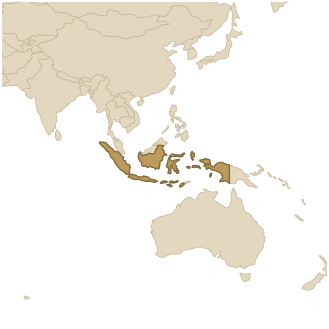
4th most populous country
~17,000 islands
+ more than 700 languages
At a glance
Indonesia is an archipelago of some seventeen thousand islands, stretched along the equator for more than five thousand kilometres from west to east. With nearly 280 million people, it is the fourth most populous country in the world and by far the one with the most Muslims. Its heart is the island of Java, one of the most densely populated places on Earth and home to the capital, Jakarta.
Geography
The country is a long chain of islands, from the largest (Sumatra, Java, Borneo, Sulawesi, New Guinea) down to thousands of islets. Lying on the Pacific Ring of Fire, it has more active volcanoes than any other country: their ash has made Java's soil very fertile, but eruptions such as Krakatoa's are remembered for their violence. The nature is tropical and lush: the rainforests of Borneo, home to orangutans, the rice terraces of Bali, and some of the richest coral reefs in the world.
Peoples and history
For centuries these islands were ruled by Hindu-Buddhist kingdoms: the maritime empire of Srivijaya, the Shailendra dynasty, which built the great Buddhist temple of Borobudur on Java around 800, and later the Majapahit Empire. From the 13th century Islam arrived through trade and gradually spread across almost the whole archipelago. Spices (clove, nutmeg, pepper) then drew the Europeans: the Portuguese in the 16th century, then the Dutch, who extended their rule over the archipelago from the 17th to the early 20th century and made it their richest colony. After the Japanese occupation, Indonesia declared independence in 1945; the Netherlands only recognised it in 1949, after four years of war.
Language and religion
More than seven hundred languages are spoken in Indonesia: Javanese, Sundanese, Balinese and many more. To unite the country, its founders chose as a common language Indonesian, based on the Malay of the traders, rather than Javanese, even though Javanese had the most speakers. The country is mostly Muslim, with an Islam that often keeps older customs alive, but its motto is "unity in diversity": the island of Bali has remained Hindu, and there are large Christian and Buddhist communities.
Culture and way of life
Indonesian culture includes batik, the art of dyeing cloth with wax, which is on UNESCO's intangible heritage list; the gamelan, an orchestra of gongs and metallophones; and wayang, the shadow theatre that replays the old epics all night long. At the table people share nasi goreng, the national fried rice, satay skewers and rendang, beef slow-cooked in spices and coconut milk.