Isle of Man
A Celtic and Viking island in the middle of the Irish Sea, a British Crown dependency with a thousand-year-old parliament, home of the tailless cat and the most dangerous motorcycle race in the world.
+ Manx (revival)
At a glance
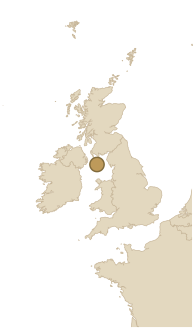
The Isle of Man sits in the middle of the Irish Sea, roughly the same distance from England, Scotland, Ireland and Wales. It is a self-governing British Crown dependency, part of neither the United Kingdom nor the European Union, with its own government and its own laws. About 85,000 people live there; the capital is Douglas. The island has its own parliament, the Tynwald, inherited from the Vikings and described as one of the oldest in the world to have sat without a break. With its Celtic and Scandinavian identity, its financial sector and its motorcycle racing, Man is attached to its separate status.
Geography
The Isle of Man is a land of green hills and ragged coastline. In the middle rise moors topped by Snaefell, the only summit from which, people say, you can see six "kingdoms" on a clear day: England, Scotland, Ireland, Wales, the island itself and heaven. Around the edge, cliffs, bays, fishing harbours and beaches face the Irish Sea. Wooded valleys (the glens), rivers, stone walls and small villages make up a gentle Celtic landscape. The climate is oceanic and cool, often windy and misty, which keeps everything green.
History
Settled by the Celts, who gave it its language and its legends, the Isle of Man was colonised in the 9th century by Norwegian Vikings, who founded a sea kingdom there and set up the Tynwald, an assembly the island traces back more than a thousand years. After the Norse period it fell under the kings of Scotland and then of England, while keeping its own laws and parliament. Long held by noble families, it was bought back by the British Crown in 1765. It gained modern self-government in the 19th century, and today finance is a large part of its economy.
Language and faith
The everyday language of the island is English, but it has its own historic language, Manx (Manx Gaelic), a Celtic language close to Irish and Scottish Gaelic; its last native speaker died in 1974, and it is now being revived and taught again. The island's tradition is Christian, shaped by Anglicanism and Methodism, the latter once strong among fishermen and farmers. Old carved crosses, Celtic and Norse, scattered around the island, show how old its Christianity is, and how it lived alongside local folklore and its legendary creatures.
Culture and way of life
Manx culture is Celtic and Scandinavian, with a folklore that has held on. The island's symbol is the triskelion, three joined legs, and its animal is the tailless Manx cat. It is a land of legends, fairies and the giant Finn McCooil, of Celtic music and dance, and of the yearly Tynwald Day ceremony, when the laws are read out in the open air. Around the world the island is best known for the Tourist Trophy, said to be the most dangerous motorcycle race in the world, run on the island's ordinary roads. The food draws on the sea and the land: Peel smoked herring (kipper), lamb and seafood.