India
A subcontinent in its own right, the most populous country on Earth, with a range of peoples, languages and gods unmatched anywhere.
most populous country in the world
+ 22 languages recognised by the Constitution, hundreds of others
At a glance
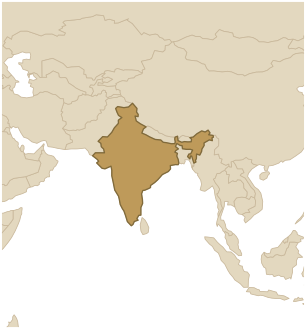
India is a subcontinent in its own right, cut off from the rest of Asia by the highest wall of mountains in the world. With more than 1.4 billion people, it became the most populous country on Earth in 2023. Its diversity is immense: hundreds of languages are spoken, thousands of gods are worshipped, and the people, the food and the dress change from one region to the next.
Geography
The country has three great parts. In the north stands the wall of the Himalayas, the highest range on the planet, where the sacred rivers rise. Below it lies the vast Ganges plain, flat and fertile, one of the most densely populated regions in the world. To the south rises the Deccan plateau, edged by two tropical coasts. Over all of it rules the monsoon: every summer its rains swell the rivers and feed the crops, and the life of the country depends on it.
Peoples and history
India's history starts very early, with the Indus Valley Civilisation and its brick cities, four and a half thousand years ago. Then came the Vedic hymns, great empires such as that of Ashoka, who embraced Buddhism and spread it, and the golden age of the Guptas. From the late 12th century Muslim dynasties established themselves in the north, and the Mughal Empire filled the country with monuments, the Taj Mahal among them. The British then made India the "jewel" of their empire. The country won independence in 1947 after a long struggle in which Gandhi's non-violence played a large part, but at the cost of Partition, which created Pakistan and uprooted millions of people.
Languages
Two great language families share the country: in the north the Indo-European languages (Hindi, Bengali, Punjabi), distant cousins of the languages of Europe; in the south the Dravidian languages (Tamil, Telugu), from another family altogether, Tamil having one of the oldest literatures still in use. Hindi and English serve as link languages, but the Constitution recognises twenty-two languages, and there are hundreds more. Indian banknotes show their value in seventeen languages.
Religions
India is the birthplace of several of the world's great religions. The great majority of Indians are Hindu: a very old faith, rich in gods, temples and festivals, built around the cycle of rebirth. Buddhism was also born in India, under the tree where the Buddha reached enlightenment, as were Jainism and Sikhism. The country also has one of the largest Muslim populations in the world, and Christians since antiquity. These religions have lived side by side for centuries, not without tension.
Culture and way of life
Indian culture is made of colours, scents and music. Its cooking is an art of spices: what is called curry covers a thousand blends, different in every family, often vegetarian. It is the country of saris, big weddings, festivals like Holi, when people throw coloured powder over each other, and Diwali, the festival of lights. And there is Bollywood, the Hindi-language cinema of Mumbai, a pillar of the world's largest film industry by number of films, whose song-and-dance films are watched far beyond India.