Ireland
The Emerald Isle on the western edge of Europe, a Celtic land of saints and poets, shaped by the great emigrations that scattered its people around the world.
and a huge diaspora
Republic of Ireland
At a glance
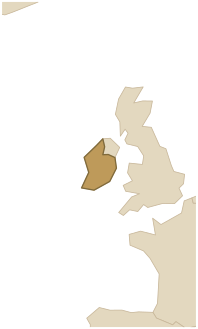
Ireland is an island at the far western edge of Europe, beyond Great Britain: past it there is only the Atlantic. It is called the "Emerald Isle" for the deep green its frequent rain gives it. The island is divided between the independent Republic of Ireland, which covers most of it, and Northern Ireland, which stayed British. More than five million people live in the Republic, around the capital, Dublin, but some seventy million people around the world claim Irish ancestry.
Geography
The island is shaped like a bowl: a central plateau of rolling plains and peat bogs, ringed by mountains and sea cliffs. The mild, very wet oceanic climate keeps it green all year: a patchwork of fields divided by stone walls and dotted with sheep. The wild, jagged west coast raises tall cliffs against the Atlantic, such as the Cliffs of Moher. There is stone everywhere: prehistoric dolmens, ruined castles and old abbeys.
Peoples and history
Ireland is one of the great heartlands of the Celtic world: never conquered by Rome, it kept the old Gaelic culture for a long time. Converted to Christianity in the 5th century by Saint Patrick, it became the "island of saints and scholars": while invasions shook Europe, its monks copied ancient learning into illuminated manuscripts such as the Book of Kells. After the Vikings, who founded Dublin, the island gradually came under English rule, the source of centuries of conflict. The defining tragedy is the Great Famine of the 1840s: potato blight killed a million people and drove millions of Irish to emigrate, above all to America. Independence came in 1922, at the cost of partitioning the island.
Language and religion
Ireland has two official languages: English, spoken by almost everyone, and Irish (Gaelic), an old Celtic language, now spoken by a minority but taught in schools. The country was long one of the most Catholic in Europe (under Protestant British rule, the faith was a pillar of identity), but society has become far more secular within a generation. Saint Patrick's Day, the national holiday, is now celebrated around the world.
Culture and way of life
For a small country, Ireland carries a lot of weight in world culture. Its literature gave us Joyce, Yeats, Wilde and Beckett, and its traditional music (fiddles, flutes and the bodhrán) is played in pubs around the world, and on stage in Riverdance. The heart of social life is still the pub, where people meet over a pint of Guinness to talk, sing and tell stories. That mix of conversation, humour and fun has a name: the craic.