Iran
Ancient Persia, one of the first great empires in history, a civilisation of poets and gardens that has carried on for thousands of years.
+ Azeri, Kurdish…
At a glance
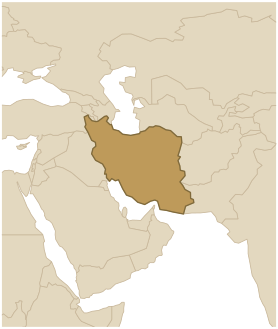
Iran, the old Persia, covers a vast high plateau in the heart of the Middle East, between the Caspian Sea and the Persian Gulf. It is one of the oldest countries in the world: its language and culture have been passed down almost without a break for nearly three thousand years. It is often confused with the Arab world around it, but most Iranians are not Arabs: they speak Persian, a completely different language, and are proud of a very old Persian identity. Some ninety million people live there; the capital is Tehran.
Geography
The country is built like a natural fortress: a huge, dry plateau ringed by high mountains, the Zagros to the west and the Alborz to the north, topped by the Damavand volcano. In the middle lie two of the driest deserts on Earth, with vast salt flats. But wherever water comes down from the mountains, people have made oases and lush gardens, using clever underground channels thousands of years old, the qanats. The north, along the Caspian, is the opposite: damp green forest.
History
In the 6th century BCE Cyrus the Great founded the Achaemenid Persian Empire, the largest the world had yet seen, stretching from the Indus to Egypt and the edge of Greece, with Persepolis as one of its capitals. After Alexander, Persia rose again under the Parthians and then the Sasanians, great rivals of Rome. The Arab conquest in the mid-7th century brought Islam; but unlike Egypt or Syria, Persia kept its language, and its culture carried great weight across Islamic civilisation. In 1501 the Safavids made Shia Islam the state religion, which still sets Iran apart today. The 1979 revolution made it an Islamic Republic, and the "Woman, Life, Freedom" uprising of 2022, after the death of Mahsa Amini, was harshly put down.
Language and religion
Persian, or Farsi, is an Indo-European language, a distant cousin of English, written in Arabic script but unrelated to Arabic. It is one of the great languages of world poetry. Iran is the main country of Shia Islam, a minority branch in the Muslim world as a whole but the majority here, which gives Iran a place of its own. The country also remembers its ancient religion, Zoroastrianism (one of the oldest religions in the world, the faith of the sacred fire and of the struggle between good and evil), which still has a few tens of thousands of followers and some of whose ideas, many historians think, shaped other religions.
Culture and way of life
Poetry has a special place in Iran: Iranians know their great poets by heart, Hafez, Saadi, Rumi, or Ferdowsi and his national epic, the Shahnameh. It is also the country of Persian carpets, prized around the world, of walled gardens with running water (the word "paradise" comes from a Persian word for a walled garden), and of the blue-tiled domes of Isfahan. At the table there is saffron rice, slow-cooked stews and plenty of fresh herbs; and every spring Nowruz, the Persian New Year, celebrates nature coming back to life.