Iraq
Mesopotamia, the "land between the rivers", one of the cradles of civilisation: some of the first cities, writing and the first written laws were born here.
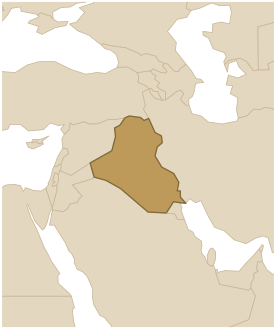
At a glance
Iraq covers ancient Mesopotamia, a Greek word meaning "the land between the rivers": the Tigris and the Euphrates, which flow down from the mountains of Turkey and meet before the Persian Gulf. On the plain between them, more than five thousand years ago, people built some of the very first cities, invented writing and drew up the first laws. Some 46 million people live there today; the capital, Baghdad, was in the Middle Ages one of the largest and most learned cities in the world.
Geography
The whole country is built around its two rivers. Their plain, in the centre and south, is the only truly fertile land, irrigated by canals for thousands of years; the cities and palm groves are concentrated there. To the north and northeast rise the mountains of Kurdistan, cooler and greener. To the west and southwest, by contrast, begins the desert that runs on into Arabia. Where the Tigris and Euphrates meet lie vast marshes, home of the "Marsh Arabs" and a UNESCO World Heritage site.
History
Few lands mattered as much at the dawn of civilisation. The Sumerians founded the first cities here and, around 3200 BCE, invented writing, cuneiform signs pressed into clay, while laying the foundations of mathematics. In Babylon, King Hammurabi had one of the first law codes carved in stone, and legend places the Hanging Gardens there. After Sumer, Akkad and Assyria, the region passed to the Persians, the Greeks and then Islam. In 762 the Abbasids founded Baghdad, which, with its "House of Wisdom" and its scholars, became the heart of the Islamic golden age until the Mongol sack of 1258. Modern Iraq emerged from the fall of the Ottoman Empire; since then it has lived through Saddam Hussein's dictatorship, several wars, the American invasion of 2003 and the war against the Islamic State.
Language and religions
Two main languages are spoken in Iraq: Arabic, the majority language, and Kurdish, in the northern mountains, where the Kurds have their own autonomous region. Assyrian Christian communities still speak Aramaic, the old language of Mesopotamia and the Bible. The country is overwhelmingly Muslim, divided between Shias, who are the majority (Najaf and Karbala are holy cities of Shia Islam), and Sunnis; it is also home to very old Christian communities, as well as the Yazidis and the Mandaeans, whose faiths go back thousands of years.
Culture and way of life
Despite all it has been through, Iraq remains a great land of culture. Poetry has held a huge place there since antiquity (the Epic of Gilgamesh, one of the oldest works of literature in the world, was born here), and Iraqis still love to recite it. Its classical music, the Iraqi maqam, is on UNESCO's intangible heritage list. At the table, dates, of which the country was long the world's leading producer, are everywhere, as is masgouf, a Tigris fish grilled at the water's edge.