Israel
A tiny land on the shore of the Mediterranean, one of the richest in history and faith anywhere, holy to the three great monotheistic religions.
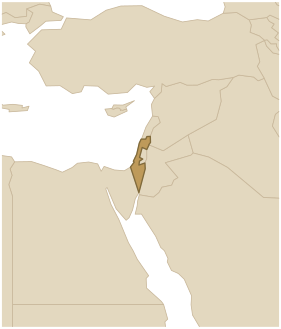
status disputed internationally
At a glance
Israel is a very small country on the Mediterranean, in the heart of the Levant, where Asia meets Africa. Few places in the world carry so much history: it is the Holy Land, birthplace of Judaism and Christianity and sacred to Islam as well, where countless places bear names from the holy books. It is also a shared and disputed land, the national home of the Jewish people, returned from their long dispersal, and the land of the Palestinian people: the region has known deep conflict, and still does. About ten million people live in Israel, a fifth of them Arabs.
Geography
On a tiny territory the country brings together very different worlds: a fertile, crowded coastal plain along the Mediterranean, where Tel Aviv lies; hills inland, where Jerusalem stands; and to the east the deep Jordan rift and the Dead Sea, the lowest point on land. In the south, the Negev desert covers more than half the country and reaches the Red Sea at the port of Eilat. Despite the dry climate, irrigation has brought crops even to the desert.
History
The history of this land spans thousands of years. It saw the birth of the kingdoms of the Bible, with Jerusalem and its Temple at their heart. After the Romans destroyed the Temple in 70 CE and crushed the Jewish revolts, a large part of the Jewish people was scattered across the world: a diaspora of nearly two thousand years that kept its bond with this land. The region then became Byzantine, then Arab and Muslim, was fought over in the Crusades, and finally became Ottoman. In the late 19th century the Zionist movement called for the return of the Jews; after the Holocaust, the State of Israel was created in 1948, and more than seven hundred thousand Palestinians were driven out or fled, what they call the Nakba. The conflict born then still marks the whole region; the Hamas attack of 7 October 2023 set off a devastating war in Gaza.
Language and religions
Israel achieved something no other country has: the revival of Hebrew. The language of the Bible, kept for nearly two thousand years for prayer and study but no longer spoken in daily life, was brought back and within a century became the everyday language of a whole country. Arabic is also widely spoken. The land is holy to the three monotheistic religions: Judaism, centred on Jerusalem and the Western Wall; Christianity, born here, with the Church of the Holy Sepulchre; and Islam, for which the Haram al-Sharif and the Al-Aqsa Mosque in Jerusalem are among the holiest places.
Culture and way of life
Israeli society brings together Jews from all over the world (Europe, the Arab world, Ethiopia, Russia), each group with its own customs, along with a large Arab population, which makes for a very diverse culture. The country is known for its tech companies, to the point of being nicknamed the "start-up nation". Its food, Mediterranean and Middle Eastern, is built on hummus, falafel, salads, citrus fruit and honey pastries. Shabbat, the weekly day of rest, and the major holidays set the rhythm of life.