Italy
The long boot reaching into the Mediterranean, cradle of Rome and the Renaissance, which left the world its law, its art and its food.
+ many regional dialects
At a glance
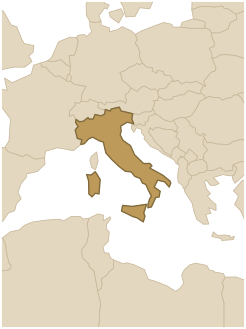
Italy has the familiar shape of a boot reaching far into the Mediterranean, with two large islands, Sicily and Sardinia. About 59 million people live there. For centuries the country was split into rival cities and kingdoms, and it keeps from that past a great variety of towns, cuisines and dialects. Its capital, Rome, is the "Eternal City", with nearly three thousand years of history.
Geography
Mountains run all through the country. The Alps close it off to the north with a wall of snow; the long spine of the Apennines then runs the whole length of the peninsula. Between the Alps and the sea lies the great Po plain, the country's farming and industrial heartland. The south and the islands are Mediterranean, planted with olive trees, vines and lemon trees under a fierce sun. Italy is also a land of active volcanoes: Vesuvius, which buried Pompeii, and Etna in Sicily, the most active in Europe.
Peoples and history
Before Rome there were the Etruscans and the Italic peoples, and the Greeks founded colonies in the south. Starting as a small village, Rome built one of the greatest empires in history, which left the world its law, its roads and Latin, and later spread Christianity. After the fall of the Empire, Italy broke up into city-states and kingdoms; out of their rivalries came the Renaissance of the 15th century (in Florence, Venice, Rome), one of the great creative moments in history. Only in 1861 did these pieces become a single nation, at the end of the Risorgimento led by Cavour, Garibaldi and King Victor Emmanuel II; Rome joined only in 1870. After Mussolini's fascism and the Second World War, the Republic was born in 1946.
Language and religion
Italian comes straight from Latin; it was standardised on the Tuscan of Dante, author of the Divine Comedy. But every region keeps its dialect, sometimes so different that it is really another language: Neapolitan, Sicilian, Venetian. Italy is the historic heart of Catholicism: it surrounds the Vatican City, seat of the papacy, and its towns are full of churches and masterpieces of religious art. Even for those who rarely go to church, religion remains bound up with culture and festivals.
Culture and way of life
Few countries have shaped Western taste as much. It is the homeland of Leonardo da Vinci and Michelangelo, of Verdi's and Puccini's operas and of Fellini's films. It also has a way of life copied around the world: the food (pasta in a thousand shapes, pizza from Naples, strong coffee, wine from every hillside), Milan fashion, and the easy pleasure of living known as the dolce vita.