Jordan
A Levantine kingdom that has stayed stable in a troubled region, a land of deserts and cities carved into rock, home of Petra and a crossroads of history since biblical times.
At a glance
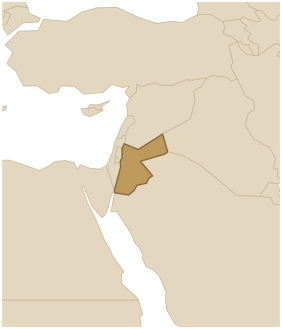
Jordan sits at a crossroads in the heart of the Levant, between Syria, Iraq, Saudi Arabia and the Jordan Valley. A small, largely desert country whose only outlet to the sea is the port of Aqaba on the Red Sea, it has built a reputation for stability and as a place of refuge in an often troubled region. About 11.5 million people live there, many of them around the capital, Amman, which is built on hills.
Geography
The country falls into three parts. In the west is the deep Jordan Valley, running down to the Dead Sea, a lake so salty that you float in it, whose shore is the lowest point on land. In the centre are cooler highlands, where most people live and the main cities stand. To the east and south stretches the vast desert that runs on into Arabia, including Wadi Rum, with its cliffs and red sand, where several films set on Mars have been shot.
History
This was the kingdom of the Nabataeans, incense traders who, more than two thousand years ago, carved the city of Petra out of rose-red rock; it is now a UNESCO World Heritage site. Rome left whole cities here, such as Jerash with its remarkably well-preserved colonnades. It is also a biblical land, where tradition places Mount Nebo, from which Moses looked out over the Promised Land, and the site of Christ's baptism on the Jordan. After the Arab conquest and the coming of Islam, the region became Ottoman, and later stood at the centre of the Great Arab Revolt of 1916. An emirate under British mandate from 1921, the Hashemite Kingdom of Jordan became independent in 1946.
Peoples, language and faith
Jordanians speak Arabic, in a Levantine dialect close to those of Syria and Palestine. To the population descended from Bedouin tribes, whose heritage is still very present, were added a great many Palestinians, refugees after 1948 and 1967, and later, with the region's wars, Iraqis and Syrians. The country is overwhelmingly Sunni Muslim, with a Christian minority that has been here since the first centuries of Christianity.
Culture and way of life
Jordanian culture mixes the Bedouin heritage of the desert with that of the Levant's towns. Hospitality matters a great deal, and guests are served Arabic coffee with cardamom. The national dish, mansaf (lamb cooked in a sauce of dried yoghurt and served on rice), is shared from a large common platter on special occasions; it is on UNESCO's intangible heritage list. The dabke, a line dance, livens up celebrations.