Japan
An archipelago at the far edge of Asia, long closed to the outside world, which built one of the most distinctive civilisations on Earth, where very old traditions sit beside the most advanced modern life.
~14,000 islands
opening to the world
At a glance
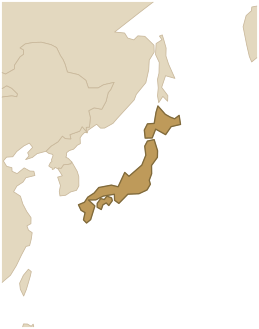
Japan is an archipelago at the far eastern edge of Asia, stretched from north to south opposite the mainland, from which the sea divides it. It is made up of four large islands (Honshū, the main one, Hokkaidō, Kyūshū and Shikoku) and some fourteen thousand smaller ones. About 124 million people live there, many of them in vast coastal cities, Tokyo among the largest in the world. As an island nation that was long isolated, the country developed a highly distinctive civilisation.
Geography
Japan is a land of mountains and volcanoes, formed where several tectonic plates meet. Nearly three-quarters of it is mountainous, so the population is packed onto narrow coastal plains and into a few basins. Above everything stands Mount Fuji, a perfectly shaped volcano and a sacred mountain. This unstable land shakes often and suffers earthquakes and tsunamis, like the one in 2011 that caused the Fukushima nuclear disaster.
Peoples and history
The settlement of Japan happened in two waves. The first inhabitants, the Jōmon, hunters and fishers for more than ten thousand years, were among the earliest potters in the world. Then, about 2,300 years ago, the Yayoi arrived from the mainland, bringing rice farming and metal: the Japanese people came from the mixing of the two. Next came the imperial court of Heian, then the long centuries of samurai warriors and shoguns. For more than two hundred years the country shut itself off almost entirely from the world, until American warships forced it open in 1853; in the Meiji era, from 1868, it modernised within a generation and became a great power. Its military expansion led it into the Second World War, which ended for Japan in 1945 with the atomic bombings of Hiroshima and Nagasaki; it then rebuilt itself into one of the world's largest economies. In the north live a distinct people, the Ainu of Hokkaidō, with origins of their own.
Language and writing
Japanese has no clear relatives outside the archipelago. Its writing system is among the most complex in the world: it combines kanji, characters borrowed from China more than a thousand years ago, with two syllabaries of Japanese origin, the kana. The language also marks politeness very finely: words and phrasing change with the respect owed to the person you are speaking to.
Religion
In Japan two religions have long been intertwined. Shinto, the ancient way native to Japan, honours the kami, spirits of nature and of ancestors, in shrines marked by their gateways, often red, the torii. Buddhism, which came from China and Korea, brought its temples, its meditation gardens and the Zen school. Most Japanese follow both: the saying goes that you are born Shinto and die Buddhist.
Culture and way of life
Few cultures are so recognisable. Japan means the tea ceremony and the art of gardens, Hokusai's prints and his Great Wave, Noh and Kabuki theatre, and cherry-blossom viewing. It has a refined cuisine, washoku, on UNESCO's intangible heritage list, that pays close attention to ingredients and seasons. And for a century it has exported a popular culture around the world: cinema, manga, anime and video games.