Kazakhstan
The vast steppe country at the heart of Eurasia, land of nomad horsemen and of the oldest known traces of horse herding, between Europe and Asia.
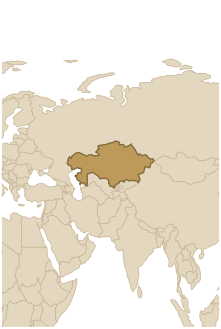
9th largest in the world
At a glance
Kazakhstan is enormous: the ninth largest country in the world and by far the largest landlocked one, roughly the size of Western Europe. It sits at the heart of Central Asia, and a small part of it, west of the Ural River, lies in Europe. Yet only twenty million people live there, because so much of the country is steppe and desert. It is the homeland of the great nomad horsemen; its capital, Astana, has been largely rebuilt in the middle of the steppe since 1997.
Geography
This is the land of the steppe: vast grassy plains that roll on without end, giving way in the south to semi-arid desert. The flatness breaks only at the edges: to the east and southeast rise the high snow-capped ranges of the Tian Shan and the Altai. In the southwest the country borders the Caspian Sea, the largest enclosed body of water in the world. The climate is extremely continental (scorching summers, freezing winters), to match these vast windswept spaces.
Peoples and history
It is on the Kazakh steppe, at the site of Botai, about five and a half thousand years ago, that the oldest known traces of horse herding are found; today's domestic horses, however, descend from another line, domesticated later further west. The steppe then belonged to the great horse-riding peoples, the Scythians with their gold treasures, then the Huns and the Turks. In the 13th century it was absorbed into the vast empire of Genghis Khan. From this nomadic world came the Kazakhs and their khanate in the 15th century. The country then came under the Russian Empire and later became a Soviet republic (the first satellite and the first man in space were launched from Baikonur), before winning independence in 1991.
Languages and religion
Kazakh is a Turkic language, a cousin of Turkish and Uzbek, long written in Cyrillic and now gradually switching to the Latin alphabet; Russian is still widely spoken, a Soviet legacy and the language of the large Russian minority. Most of the country is Sunni Muslim, with an Islam mixed with old nomadic traditions and respect for ancestors and nature; the Russian and Ukrainian minority is Orthodox Christian by tradition.
Culture and way of life
Kazakh culture is that of the steppe nomads, and it is still very much alive. There is the yurt, the round felt tent that is easy to take down, the horse, a lifelong companion, and horseback games. There is hunting with the golden eagle, an art handed down through the generations, in which the rider sends the bird after its prey. The music of the dombra, a two-stringed lute, accompanies long epic tales. At the table people share horse meat and mutton, and kumis, fermented mare's milk.