Kyrgyzstan
The country of the Celestial Mountains and great lakes in Central Asia, a land of nomad horsemen, yurts and the great epic of Manas.
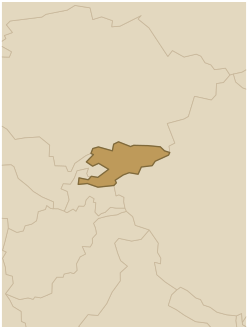
At a glance
Kyrgyzstan is a landlocked country of high mountains in Central Asia, between Kazakhstan, China, Tajikistan and Uzbekistan. It is the land of the Celestial Mountains, the Tian Shan, which cover most of it. About seven million people live there; the capital is Bishkek. The Kyrgyz are a Turkic-speaking people with a deep nomadic tradition: more than their neighbours, they have kept alive the world of the yurt, the horse and the summer pastures, along with a very rich oral culture. Long the most open country in the region, Kyrgyzstan has seen its government become much more authoritarian since 2021.
Geography
Kyrgyzstan is a land of mountains: the ranges of the Tian Shan, the "Celestial Mountains", cover it with snowy peaks, glaciers and high pastures, the jailoo, where herders go up in summer with their flocks and yurts. In the middle lies Issyk-Kul, the second-largest mountain lake in the world, which never freezes despite its altitude. Waterfalls, gorges, walnut forests and green valleys complete the landscape.
History
A land of nomad horsemen since antiquity and crossed by the Silk Road, the region saw countless steppe peoples pass through and mix. The Kyrgyz keep the memory of their history in a monumental work, the epic of Manas: the story of a founding hero, one of the longest epic poems in the world, passed down orally by bards and listed by UNESCO as intangible heritage. Long under the sway of various khanates, the region was conquered by the Russian Empire in the 19th century and later became a Soviet republic. Since independence in 1991, Kyrgyzstan has seen three popular uprisings (2005, 2010, 2020) that overthrew the government of the day.
Language and faith
Kyrgyz is a Turkic language, a cousin of Kazakh, long purely oral and rich in poetry; Russian is still widely used, a Soviet legacy and an official language alongside Kyrgyz. Most of the country is Sunni Muslim, with an Islam deeply mixed with the old beliefs of the steppe: respect for nature, for the sky (Tengri) and for the ancestors, inherited from nomadic shamanism, still runs through rituals and festivals.
Culture and way of life
Kyrgyz culture is that of the mountain nomads, and it is still very much alive. There is the yurt (the boz üy), set up on the summer pastures, whose wooden crown appears on the national flag; the horse, an age-old companion, and horseback games such as kok-boru, in which riders fight over a goat carcass. There is also eagle hunting, feltwork (the brightly patterned shyrdak rugs) and the bards who recite Manas. Life revolves around the herd, beshbarmak (meat and noodles), bread and kumis, fermented mare's milk.