Cambodia
The country of the Angkor temples, heir to the great Khmer empire, a land of the Mekong and its great lake, in the heart of Southeast Asia.
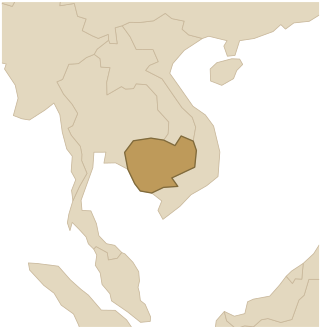
At a glance
Cambodia is a country in Southeast Asia, between Thailand, Laos and Vietnam, opening to the south onto the Gulf of Thailand. It is the heart of a very old civilisation, that of the Khmers, who built one of the great empires of Southeast Asia and the largest temple complex in the world, Angkor. About seventeen million people live there; the capital is Phnom Penh. A land of rice fields, temples and the great Mekong river, Cambodia carries the memory of a glorious past and of a recent tragedy.
Geography
The country is built around a large central plain, drained by the Mekong and by a lake that behaves like no other, the Tonlé Sap: every year, in the monsoon, the swollen Mekong reverses the flow of the river that links the lake to it, and the lake grows to five times its size. This rise and fall feeds millions of people and one of the richest freshwater fisheries in the world. Around it stretch huge rice fields, a few forested mountain ranges (the Cardamoms, the Dângrêk) and, in the south, a coast of beaches and islands that are still little developed.
History
From the 9th to the 15th century the great Khmer empire flourished, one of the most powerful civilisations in Asia, whose capital, Angkor, may have been the largest city of the pre-industrial world. Hundreds of temples were built there, among them the colossal Angkor Wat, the largest religious monument in the world, which appears on the national flag. After the empire declined, Cambodia became a French protectorate in 1863 and won independence in 1953. It then suffered one of the worst tragedies of the 20th century: the Khmer Rouge regime (1975–1979), which in four years caused the deaths of nearly a quarter of the population. Long ruled by Hun Sen, the country has been governed since 2023 by his son, Hun Manet.
Language and faith
People speak Khmer, an old language with a rounded script derived from Indian writing, unrelated to Thai, Vietnamese or Chinese: it is one of the main languages of the Mon-Khmer family. Cambodia is a deeply Buddhist country, of the Theravada tradition like Thailand and Laos: golden pagodas, monks in saffron robes and the religious calendar set the rhythm of life. Beneath the Buddhism, old animist beliefs and the memory of Angkor's Hindu gods live on.
Culture and way of life
Khmer culture is the heir to Angkor. There is classical dance, with its slow gestures and curved hands, on UNESCO's intangible heritage list, whose dancers in golden headdresses bring to life the apsaras carved on the temples. There are silk weaving, silverwork and sculpture. Life follows the rhythm of the rice field, the river and the pagoda, and the food follows that of rice, fish from the Tonlé Sap, amok, fish cooked in coconut milk in a banana leaf, and tropical fruit.