Saint Kitts and Nevis
Two small volcanic islands in the Antilles, the smallest country in the Americas, a former British sugar colony whose people are mostly of African descent.
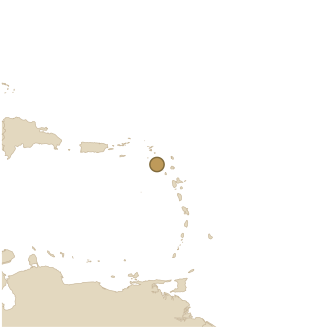
+ Creole
At a glance
Saint Kitts and Nevis is the smallest country in the Americas, both in area and in population: two small volcanic islands in the Lesser Antilles, separated by a narrow channel. Fewer than fifty thousand people live there, the great majority of African descent; the capital, Basseterre, is on Saint Kitts (officially Saint Christopher). The island was the first English colony in the Caribbean, the "mother colony" of the British West Indies. Long made rich by sugar, the country now lives mainly on tourism: visitors come for the green landscapes, the historic forts and the quiet island life.
Geography
Both islands are volcanic, mountainous and green. Saint Kitts is dominated by Mount Liamuiga, a dormant volcano covered in rainforest, whose slopes, once planted with sugar cane, run down to beaches of pale or black sand. Nevis, its almost perfectly conical neighbour, is a single volcano ringed with cloud, surrounded by quiet beaches and hot springs. A reef-strewn channel, "the Narrows", separates the two islands. The tropical climate is softened by the trade winds, but hurricanes still strike.
History
Inhabited by Amerindian peoples, the islands saw the first English colony in the Caribbean founded in 1624, soon joined by the French; in 1626 English and French settlers together massacred the island's Kalinago people. Saint Kitts then became the springboard for British colonisation of the Caribbean. The settlers built a rich sugar economy on the enslavement of thousands of Africans, from whom most of the population descends; the fortress of Brimstone Hill, a UNESCO World Heritage site, dates from that time. Nevis is the birthplace of Alexander Hamilton, one of the founding fathers of the United States. After slavery was abolished in 1834, Saint Kitts and Nevis became, in 1983, the last country in the English-speaking Caribbean to gain independence.
Language and faith
The official language is English, but in daily life people speak a Caribbean English creole. The country is deeply Christian, with strong Anglican and Methodist traditions inherited from the British, alongside other churches; faith plays a large part in community life, mixed with cultural traditions of African origin.
Culture and way of life
Kittitian culture is Afro-Caribbean and festive. Its biggest event is carnival ("Sugar Mas"), between Christmas and New Year, with parades, masks, Mummies and Moko Jumbies (stilt dancers), soca and steelpan. Music, dance and cricket, inherited from England, set the rhythm of life. The Creole cooking centres on saltfish and johnnycake, rice and peas, chicken and seafood.