South Korea
An East Asian peninsula with a strong character of its own, caught between powerful neighbours, which kept its language and now exports its culture around the world.
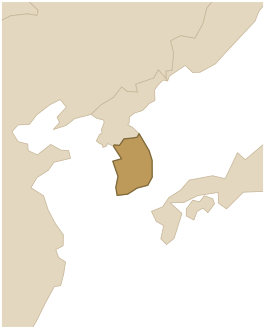
At a glance
South Korea occupies the southern half of an East Asian peninsula that reaches out between China and Japan: between these two giants it has forged, not without difficulty, a very strong and distinct identity. It is a crowded, mountainous country, where some 52 million people live, many of them in huge cities, starting with the capital, Seoul, one of the largest urban areas in the world. In a single generation South Korea went from poverty to wealth and to the cutting edge of technology: what became known as the "Miracle on the Han River".
Geography
Korea is a land of mountains and sea: wooded, revered mountains cover most of the country, and people are concentrated in the few plains and valleys. The coast, very ragged in the west and south, is scattered with thousands of islands. The country has four distinct seasons (hot, humid monsoon summers and dry, cold winters from Siberia) and celebrates their passing, especially the cherry blossom and the autumn colours. To the north, one of the most tightly closed borders in the world separates it from North Korea.
History
After ancient kingdoms, the peninsula was unified in the 7th century, then ruled by the Goryeo dynasty, which gave Korea its name, and finally, for five centuries, by the deeply Confucian kings of Joseon. One of them, King Sejong, had an alphabet made for Korean in 1443, hangul, which linguists often cite as one of the most logical writing systems in the world. The 20th century was brutal: harsh Japanese colonial rule (1910–1945), the division of the peninsula in 1945, then the Korean War (1950–1953), which killed millions. Starting from deep poverty, the South became within a few decades one of the world's major economies, and a democracy since the late 1980s.
Language and faith
Korean is generally considered a language isolate, with no proven link to Chinese or Japanese, and its script, hangul, has the rare distinction of having been invented all at once, to a precise design, so that everyone could learn it easily. When it comes to belief, Korea is unusual in Asia: Confucianism still governs family relations and respect for elders, Buddhism keeps its mountain temples, and Christianity, which spread very quickly, now claims nearly a third of the population, on an old base of shamanism. Even so, more than half of Koreans say they have no religion.
Culture and way of life
South Korea has become a global cultural power: the Korean Wave, or "Hallyu", has taken K-pop, TV dramas and its cinema everywhere, with Parasite winning both the Palme d'Or and the Oscar for Best Picture. But the culture runs deep: the food, built around rice and kimchi, the fermented spicy cabbage served at every meal, whose communal making is on UNESCO's intangible heritage list, and Korean barbecue shared at the table; martial arts such as taekwondo; and the palaces and temples of the Joseon era.