Kuwait
A small emirate at the head of the Persian Gulf, once a town of sailors and pearl divers, made rich by oil, a land of trade and the sea.
the highest-valued currency in the world
At a glance
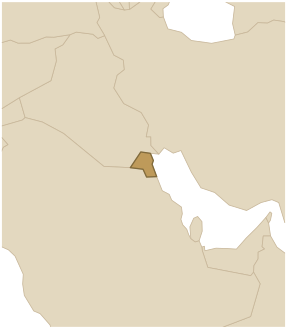
Kuwait is a small emirate at the head of the Persian Gulf, squeezed between Iraq and Saudi Arabia. Small as it is, it is one of the richest countries in the world thanks to its huge oil reserves, and its dinar is the highest-valued currency in the world. Nearly five million people live there, about two-thirds of them foreigners who came to work; the capital is Kuwait City. Before oil it was a small town of sailors, merchants and pearl divers, and the country keeps a trading tradition from that seafaring past.
Geography
Kuwait is almost entirely flat desert: a stretch of sand and gravel with one of the hottest climates in the world, where summer temperatures can top fifty degrees. It has no rivers or lakes, and its fresh water comes from desalinated seawater. Everything faces the Gulf: a deep bay shelters the main port and the capital, and a few islands lie offshore, such as Failaka, inhabited since antiquity. The coast, once the domain of the pearl divers, is now dominated by the modern skyline of the city.
History
Founded in the 17th century, Kuwait prospered as a trading port and a major centre of pearl diving and shipbuilding in the Gulf; it has been ruled by the Al-Sabah dynasty since the 18th century. A British protectorate from 1899, it was transformed by the discovery of oil in 1938 and became independent in 1961, one of the richest countries in the world. Its recent history was marked by Saddam Hussein's invasion from Iraq in 1990 and by the Gulf War that freed the country in 1991, leaving hundreds of oil wells on fire. Its parliament, long one of the most powerful in the region, was suspended by the emir in 2024.
Language and faith
Kuwaitis speak Arabic, in a Gulf dialect, while English and the languages of the large foreign community, mostly Asian, are heard everywhere. The country is mainly Muslim, with a large Shia minority, about a third of Kuwaiti citizens, alongside the Sunni majority. Islam shapes daily life, festivals and the calendar; Kuwait also has a tradition of public debate livelier than elsewhere in the Gulf.
Culture and way of life
Kuwaiti culture keeps the memory of its seafaring past alive: dhows, the wooden sailing boats, remain a national symbol, and the days of pearl divers and sailors live on in songs (sawt) and stories. Social life revolves around the diwaniya, a reception room where men meet in the evening to talk and drink coffee, an informal forum for debate that carries weight in the country's life. Guests are offered cardamom coffee and dates; the national dish is spiced rice with fish or lamb (machboos).