Laos
A country of mountains and the Mekong, the only landlocked state in Southeast Asia, a land of temples and Theravada Buddhism.
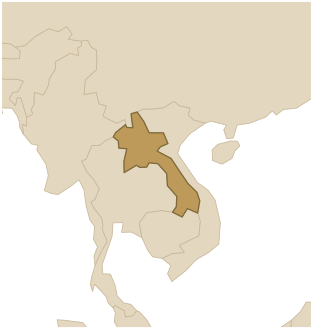
At a glance
Laos is the only country in Southeast Asia with no coastline, a mountainous, forested land boxed in by China, Vietnam, Cambodia, Thailand and Myanmar. The great Mekong river, which runs through it and then forms much of its border, is its lifeline. About seven and a half million people from many different peoples (the state recognises around fifty) live there; the capital is Vientiane. It is one of the most thinly populated countries in the region.
Geography
Three-quarters of Laos is mountains and plateaus, green and forested, where hill peoples live in villages perched on the slopes. The Mekong runs through a fertile valley where the rice fields, towns and most of life are concentrated; in the south it spreads out into a maze of islands and waterfalls, Si Phan Don, the "four thousand islands". The country still has large tropical forests, rich in rare wildlife, and remains that are still poorly understood, such as the Plain of Jars with its thousands of giant stone jars from the Iron Age.
History
In the 14th century Laos was the great kingdom of Lan Xang, "the land of a million elephants", ruled from Luang Prabang. Later broken up and then placed under French protection as part of Indochina, it became independent in 1953. Caught up in the Vietnam War, this small, officially neutral country was secretly subjected to massive American bombing, more than two million tonnes of bombs, making it the most heavily bombed country per person in history; millions of unexploded munitions still kill and maim people in the countryside. In 1975 the communist Pathet Lao took power and set up the people's republic that still rules the country.
Language and faith
People speak Lao, a language of the large Tai family, close to Thai and written in a rounded script, alongside dozens of languages of the hill peoples (Hmong, Khmu and many others). Laos is a deeply Theravada Buddhist country, like Thailand and Cambodia: golden temples (wats) and monks in saffron robes collecting alms at dawn are at the heart of daily life. Beneath the Buddhism, especially among the hill peoples, old animist beliefs live on in the worship of spirits (phi).
Culture and way of life
The best-known town in the country is Luang Prabang, a former royal city with dozens of temples and a UNESCO World Heritage site, where every morning monks walk in silence to receive rice from the faithful. The baci ceremony marks life's big moments: cotton threads are tied around the wrist to call back the souls and wish good fortune. The music of the khaen, a bamboo mouth organ, is on UNESCO's intangible heritage list. The fragrant cooking centres on sticky rice rolled by hand, laap (a minced-meat salad) and fresh herbs.