Lebanon
A small mountain country on the Mediterranean, homeland of the ancient Phoenicians, shared by many communities and with a huge diaspora.
but a far larger diaspora
+ French and English widely used
At a glance
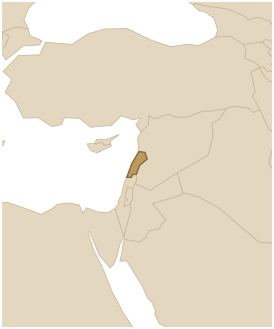
Lebanon is a tiny country, one of the smallest in Asia, squeezed between the Mediterranean, Syria and Israel at the eastern end of the sea. Yet its history is far denser than its size would suggest. It is a country of mountains that drop almost straight into the sea, and a country of communities: Christians of several churches, Sunni and Shia Muslims and Druze live side by side in a fragile balance. It is often said that there are more Lebanese abroad than in Lebanon itself, so large is the diaspora. The capital is Beirut.
Geography
The whole country fits into a few parallel strips. First a narrow Mediterranean coast, crowded with towns; then, straight away, the Mount Lebanon range, whose snowy peaks tower over the sea, so that, people say, you can ski in the morning and swim in the afternoon. Behind it lies the fertile Bekaa Valley, the country's granary and vineyard, then a second range, the Anti-Lebanon, along the Syrian border. These mountains were once covered in cedars, of which only a few groves remain; the tree appears on the flag.
History
This coast is the land of the Phoenicians, the seafaring traders who, from Tyre, Sidon and Byblos, sailed the whole Mediterranean a thousand years before the common era, founded Carthage and gave the world the alphabet, the ancestor of most alphabets in use today. Rome built the colossal temples of Baalbek here; Christianity took root early, notably among the Maronites, who took refuge in the mountains. Under Islam, the mountains remained a refuge for many communities. In 1920 France created Greater Lebanon, which became independent in 1943. The country went through a long civil war (1975–1990); since 2019 it has been in a deep economic crisis, made worse by the Beirut port explosion of 2020 and the war between Israel and Hezbollah in 2024.
Languages and religions
People speak Lebanese Arabic, but the country is largely trilingual: French and English are everywhere, often in the same sentence, a legacy of its schools and its openness to the world. What sets it apart most is religion: no community is a majority, and power is shared among the eighteen recognised communities. The president is a Maronite Christian, the prime minister a Sunni and the speaker of parliament a Shia. This power-sharing, a source of tension and deadlock, is also central to the country's identity.
Culture and way of life
Lebanon is famous for its food: mezze, a spread of small dishes to share (hummus, tabbouleh, kibbeh, falafel), olive oil and za'atar, all with arak. It is also the voice of Fairuz, a singer loved across the Arab world, and the poetry of Khalil Gibran, whose The Prophet is read all over the world. The Lebanese diaspora has carried this culture to Brazil, West Africa and throughout the Americas.