Liberia
The "land of the free" on the Atlantic coast, founded by freed slaves from America, Africa's oldest republic.
+ local languages
At a glance
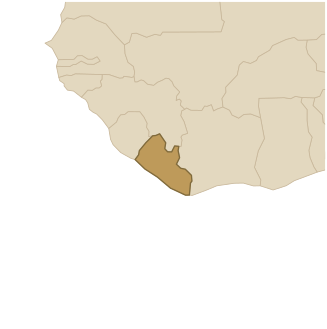
Liberia is a country in West Africa, on the Atlantic coast, whose name means "land of liberty". Its history is unique on the continent: it was founded in the 19th century by freed slaves from the United States, who in 1847 declared Africa's oldest republic, never colonised by a European power. More than five million people live there, descendants of those African American settlers and members of many Indigenous peoples; the capital, Monrovia, is named after an American president. A land of forests and beaches, Liberia has recovered from devastating civil wars.
Geography
Liberia is hot and humid, largely covered in rainforest: it holds nearly half of what remains of the Upper Guinean primary forest, a refuge for rare wildlife such as forest elephants, pygmy hippos and chimpanzees. The Atlantic coast is lined with long sandy beaches, lagoons and mangroves, often pounded by heavy surf. Inland the forest gives way to plateaus and hills. The country gets some of the heaviest rainfall in Africa, which feeds dense vegetation and many rivers.
History
Long home to peoples of the forest and the coast, the region saw freed African Americans arrive from 1822, sent by an American society to "return" to Africa. In 1847 they founded the Republic of Liberia on the American model: a flag with stars and stripes and a capital named after President Monroe. But this "Americo-Liberian" elite long dominated the Indigenous peoples; that divide, among others, led to the 1980 coup and then to two atrocious civil wars (1989–2003). The country recovered and in 2005 elected Ellen Johnson Sirleaf, the first woman elected head of state in Africa and later a Nobel Peace Prize laureate.
Languages and faith
The official language is English, inherited from the African American founders and spoken in a distinctive Liberian form; alongside it are some thirty Indigenous languages, such as Kpelle, Bassa and Vai, which even has its own script, invented in the 19th century. Liberia is mostly Christian, a legacy of the settlers and the missions, with a Muslim minority and a strong presence of traditional religions and their initiation societies, such as Poro and Sande.
Culture and way of life
Liberian culture has two sources: the Creole, America-facing culture of the freed settlers' descendants, and the deeply African cultures of the many Indigenous peoples. The initiation societies (Poro for men, Sande for women) have their masks, including the famous Sande helmet masks. There is music and dance, too, and a passion for football, which gave the country its greatest hero, George Weah, winner of the 1995 Ballon d'Or and president from 2018 to 2024. Life revolves around rice, the staple food, leaf sauces (palava sauce) and fish.