Libya
A vast land of desert and Mediterranean coast, of ancient cities and caravans, at the heart of the Sahara between the Maghreb and Egypt.
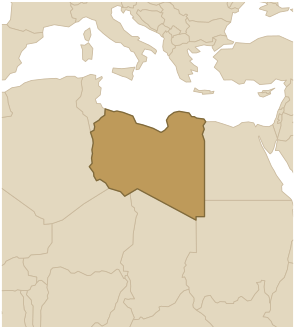
4th largest in Africa
+ Berber
At a glance
Libya is a vast country in North Africa, one of the largest on the continent, with the Mediterranean to the north and more than nine-tenths of its land covered by the Sahara. Almost the entire population, just over seven million people, is packed into the narrow coastal strip, around the capital, Tripoli, and the big eastern city of Benghazi. Rich in oil, Libya has been deeply divided since the fall of Gaddafi in 2011.
Geography
The Sahara covers nearly all of Libya: seas of dunes, rocky plateaus, black mountains in the south and isolated oases where precious water reaches the surface. Beneath the desert lie huge reserves of fossil water, which a giant pipeline network, the "Great Man-Made River", carries to the coast. It is along the Mediterranean coast that the towns, the farmland and a milder climate are found, between Tripolitania in the west and Cyrenaica in the east.
History
This coast was one of the great centres of the ancient world: the Phoenicians founded Tripoli, the Greeks Cyrene, and Rome built Leptis Magna, birthplace of the emperor Septimius Severus, whose ruins are among the best preserved in the Roman world. The Arab conquest of the 7th century brought Islam and Arabic to a land that had been Berber. Long an Ottoman province, Libya was colonised by Italy from 1911 and became an independent kingdom in 1951. Colonel Gaddafi, who seized power in 1969, was overthrown in 2011; since then the country has been torn by conflict and split between two rival governments, in the west and the east.
Language and faith
Libyans speak Arabic, in a Maghrebi dialect, while Berber (Amazigh) communities keep their language in a few regions and oases, as do the Tuareg and the Toubou in the far south. The country is almost entirely Sunni Muslim, a faith that shapes social life, festivals and the calendar. This Islam bears the mark of Sufi brotherhoods such as the Senussi order, which produced King Idris, the first ruler of independent Libya.
Culture and way of life
Libyan culture mixes the Arab-Berber heritage, the Mediterranean and the desert. Life revolves around tea, brewed slowly, the extended family and welcoming guests. People eat couscous, spiced soups such as shorba and dates from the oases; the markets sell leather and silver crafts. In the far south the world of the caravans and the Tuareg, the "blue men" of the desert, lives on.