Liechtenstein
A tiny Alpine principality between Switzerland and Austria, one of the smallest and richest countries in the world, squeezed between the Rhine and the mountains.
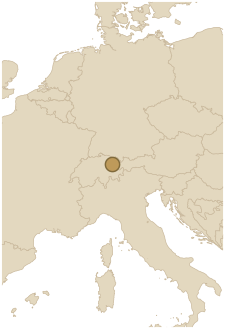
At a glance
Liechtenstein is a tiny Alpine principality, one of the smallest countries in the world, squeezed between Switzerland and Austria along the Rhine. It is one of only two "doubly landlocked" countries in the world, along with Uzbekistan: it has no coast, and neither do any of its neighbours. About 40,000 people live there; the capital, Vaduz, sits below the prince's castle. Liechtenstein is one of the richest countries in the world per person, a financial centre with high-tech industry. It is also one of the last monarchies in Europe where the prince still holds real power, at the head of one of the oldest reigning families on the continent.
Geography
Liechtenstein spans two worlds within a few kilometres. In the west, the fertile Rhine plain, which forms the border with Switzerland, holds the towns, industry and villages. In the east, the Alps rise suddenly: steep mountains, valleys, high pastures and snowy peaks cover most of the country, with hiking in summer and skiing in winter. Vineyards on the sunny slopes, forests and meadows complete the landscape.
History
Roman and then Germanic, the region was brought together in 1719 as the principality of Liechtenstein, named after a wealthy Austrian family that had bought the land to gain a seat in the Imperial Diet; no prince actually lived there until 1938. The country became fully sovereign when the Holy Roman Empire was dissolved in 1806. Neutral, it disbanded its army in 1868 and stayed out of both world wars. Long a poor farming country, it was transformed in the 20th century into one of the most prosperous and industrialised economies in the world, while keeping its monarchy and its traditions.
Language and faith
People in Liechtenstein speak German, in an Alemannic dialect close to that of neighbouring Switzerland and different from standard German. The country is deeply Catholic by tradition: Catholicism is even the state religion, which is rare in Europe, and religious holidays mark the calendar. Attachment to custom, family and village life remains strong.
Culture and way of life
Liechtenstein's culture is that of the German-speaking Alpine valleys, shaped by the mountains, tradition and loyalty to the prince. The national day, on 15 August, is the high point: the prince invites the whole population into the castle gardens. There are also the castles, the princely art collection, the carnival brass bands (Guggenmusik), village festivals and Alpine traditions. The food is German and Swiss in style, with wine from the slopes and Käsknöpfle (small cheese dumplings), the national dish.